Barnesfolio

    • REFERENCES & NOTES
    • The Definition of Consciousness: Me, I, My and Us, the MIMU of Self
    • About
    • 2012 Reading

  • Part I: PRELUDES OF CHANGE

    The Definition of Consciousness
    Me, I, My and Us, the MIMU of Self
    BY LYNARD – OCTOBER 12, 2020

    A year or so ago I set out to write a series of posts as a follow up to my 2012 book A SHORT HISTORY OF MEMORY. I slowly and methodically went through the tedious process of reading and collecting reference material.

    The book prompting this latest venture into the world of neuroscience was Michael S. A. Graziano’s1. Unlike some denser neuroscience works, Graziano explains the basics, lays out the foundation for what, he contends, may eventually be a full explanation of consciousness. He also raises some really, really important questions. One of those questions, the most important question he raises in fact is the central idea I presented as foundational to any explanation of consciousness. RETHINKING CONSCIOUSNESS makes an enormous contribution to setting the parameters around any valid definition of consciousness. Unfortunately, Graziano’s approach to a possible definition of consciousness is wrapped around the idea of humans as biochemical machines that can be emulated by a computer. The idea is quaint.

    In what I can only regard as a serendipitous interruption of my plan for a series of posts following up on my book, I read Douglas Phillips’ science fiction adventure, PHENOMENA: A NEUROSCIENCE THRILLER2. Phillips is not a neuroscientist. His forte is physics, quantum physics specifically, and computer science. A prolific author with an entire series of novels centered around quantum physics, in PHENOMENA, Phillips approaches the question of consciousness in the only way it can be approached if we are ever to arrive at an understanding. However, antithetical to every “serious” discussion of consciousness, Phillips’ deus ex machina is an alien intelligence of shared consciousness, which sort of begs the question–what is consciousness of an alien intelligence. Stripped of the alien intelligence aspect of the novel, Phillips zeros in on both the confining constraints of any real definition of consciousness and how it can really be defined.

    Since A SHORT HISTORY OF MEMORY neuroscience has continued progress on mapping the biochemical intricacies of the brain. The proliferation of theories on how the brain and mind work has also continued. What has remained consistent however is the analogy of the brain as a computer. From memory as computer-like random access memory to perception and reaction as a complex neural network of inputs and outputs. Of course using computer structure as an analogy for the way the brain works greatly simplifies explanations of how the brain works. It does nothing to explain consciousness despite the relevancy of complex neural networks or topography of Graziano’s “attention schema” theories.

    © Lynard Barnes, 2020

    Share this:

    • Share on X (Opens in new window) X
    • Share on Facebook (Opens in new window) Facebook
    • Print (Opens in new window) Print
    Like Loading…
    May 24, 2023

  • Exploring Definitions: Born vs. Naturalized in Law

    30% of any given population will hold radically different views than the majority of the population.

    There is a diplomatic way of saying this: In most large, diverse populations, a significant minority—often on the order of a quarter to a third—will differ from the majority on at least some widely held social and political ideas. Which brings us to the opinion polls showing 32-36% of Americans support the current policies of the U.S. President. In turn, this brings us to a court case currently pending before the U. S. Supreme Court.

    Read the following. If you have a high school or higher level of education, you may be able to understand this. From a musical thought from Sam Cook, you may not know much about history, much about biology, much about a science book, much about the French YOU took, but obviously you can read. Try this:

    All persons born or naturalized in the United States, and subject to the jurisdiction thereof, are citizens of the United States and of the State wherein they reside. No State shall make or enforce any law which shall abridge the privileges or immunities of citizens of the United States; nor shall any State deprive any person of life, liberty, or property, without due process of law; nor deny to any person within its jurisdiction the equal protection of the laws.

    This is Section 1 of the 14th Amendment of the U. S. Constitution.

    We may not know what “born” and “naturalized” mean nor “subject to the jurisdiction” means. But we get the general gist of the paragraph. However, if you went to law school you may have questions. Like, “What does ‘born’ really mean? What does ‘naturalized’ mean? Or, ‘subject to the jurisdiction’?

    Because of the 30% mythology, we must acknowledge that there are some who do not know the meaning of these terms. If such people went to law school, they may require definitions more explicit than the standard definition provided by the 2, 662 page WEBSTER’S THIRD NEW INTERNATIONAL DICTIONARY with fifteen copyrights from 1909 to 1971. As a public service, the definition for the terms in question are offered, more or less, from the aforementioned dictionary.

    Definitions – More or Less

    “born” – “brought into existence by or as if by birth.”

    Now, let’s be honest here without snark (whatever that is). This definition only begs the question, What is ‘birth’? Within the context of the 14th Amendment, a person is “brought into existence” by being born. At our current level of technological development, there is only one way to bring a person into existence. A woman goes through a period of gestation–development of an embryo which evolves into a fetus–and thereby brings a person into existence. Bringing a person into existence is no easy task. The process might take a couple of minutes or hours, not to mention the events preceding a pregnancy. In her book Rough Draft: A Memoir, Katy Tur (Katherine Bear Tur-Dokoupil) provides a very informative exposition on the process of bringing a person into existence. Very easy to understand. We suspect however that there are at least two, maybe three justices, one of whom is caught-up in religious dogma, on the Supreme Court who don’t get it. Even with pictures they would not understand how a person is brought into existence.

    “naturalized”-”to establish in new surroundings: introduce into common use”

    Wo!. This is a rather heavy. There is obviously a process related to “naturalized” as there is to “born”. Unlike “born”, there is no clear, straightforward explanation. Let us go bureaucratic. First, there must be a person in existence. The person must submit a Form N-400, submit to an interview with a representative of the U.S. Immigration and Naturalization Service, take a civics test and swear an Oath of Allegiance to the United States–which once meant something to government officials taking the oath but is now just a mumble of words signifying nothing.

    “subject to the jurisdiction”

    Let’s start with the really, really big word here.: “subject”. The person brought into existence by being born is the “subject”. The act of being born introduces the person into “new surroundings”. Dovetails with the definition of “naturalized” in a very logical way. So now, we must examine this word “jurisdiction”. It is one of my favorite words because there is rarely an opportunity to use it. I would like to be able to say, My car is under my jurisdiction. Two realities make such a statement stupid: (1) I own the car. I determine where it goes, when it goes and, within physical limits, how it goes. This is ownership, not jurisdiction. (2) The car, even if equipped with the latest, smartest artificial intelligence capable of letting the car drive itself, ownership and responsibility trumps (oops) jurisdiction. Ownership and responsibility resides with me while jurisdiction resides with the city, state, etc.. WEBSTER’s definition of jurisdiction makes it rather clear:

    “The legal power, right, or authority to hear and determine a cause considered either in general or with reference to a particular matter: legal power to interpret and administer the law in the premises”.

    Simple question: who has jurisdiction over a person brought into existence in “new surroundings” or premises?

    So, we have Supreme Court Justices consisting of lawyers. Lawyers may not be the best custodians of the U. S. Constitution. Especially lawyers with an agenda. Especially lawyers who can determine without a grimace that all are equal under the law EXCEPT the President.

    The question of Birth Right Citizenship was decided in 1898 and pretty much follows the definitions given here. Yet, yet! there is that 30 to 36%.

    Share this:

    • Share on X (Opens in new window) X
    • Share on Facebook (Opens in new window) Facebook
    • Print (Opens in new window) Print
    Like Loading…
    January 9, 2026
    History, law, news, Politics, trump

  • The Definition of Consciousness – Interlude Nostradamus

    Me, I, My and Us, the MIMU of Self
    BY Lynard – August 2025

    Nostradamus, Fidelity and Infidelity

    A focus on the Nostradamus rarely discussed Epistle to King Henry II of France and the conflict in America.

    Mention Michel De Nostradame in any conversation regarding politics, you get instant eye-rolls. For ostensibly good reasons. If you search the internet for Nostradamus predictions you will see everything from upcoming earthquakes, deadly viruses, the death of the high and mighty and a host of other every-day historical minutiae.

    As Nostradamus observers have noted, Nostradamus was a Jew who converted to Catholicism. He was also a respected physician and, more importantly, a Frenchman. Most of all, a Frenchman. To a fault really. After he published a successful almanac in 1550 he gained support from patrons as an astrologer. In 1555 he published Les Prophéties, which we today refer to as the Nostradamus prophecies. The collection of prophecies consists of 942 “poetic” quatrains with each collection of a hundred known as a Century.

    Not to be ignored, England had its own prophetess known as Mother Shipton, or Ursula Southheil. She lived from 1487 to 1561, almost a contemporary of Nostradamus. Aside from a very eventful life and an even more eventful legend surrounding her life, Mother Shipton, focused on future events impacting her immediate environs.

    Then there is America’s own Edgar Cayce . His prophecies were more oriented toward the lost continent of Atlantis and spiritual matters. The most interesting prophecy Cayce has made concerns China becoming a “Christian” nation. It dovetails with a prediction Nostradamus hints at. Both Cayce and Nostradamus use the word “Christian” and if you are at all familiar with the history of Western religion (going back to its foundation in the ancient Sumerian civilization) , you know they are referring to the teaching of Jesus of Nazareth, not the Catholic nor Protestant churches.

    The Genesis of America

    The Christian Church is the prism through which Nostradamus opines about the future. He mentions the Christian Church numerous times in the Epistle to his prophecies dedicated to King Henry II of France. It is in the Epistle that he makes a subtle distinction between the Catholic Church (which he refers to simply as the Church) and the Christian Church. He also makes a distinction between the Christian Church and the “pagan sect of new infidels”–in other words, Protestants.

    It is when he writes about the birth of America that he makes this last distinction. I quote this paragraph in detail because, myself not being a “religious” denizen, it has fascinated me since I first read it. (Emphasis added, notes added below quote).

    “For God will take notice of the long barrenness of the great dame1 [France], who thereupon will conceive two principal children2 [American Rebellion and French Revolution]. But she [First France Republic] will be in danger, and the female [America] to whom she will have given birth will also, because of the temerity of the age 3, be in danger of death in her [“her” undefined”] eighteenth year4, and will be unable to live beyond her thirty-sixth year. She will leave three males, and one female5, and of these two will not have had the same father [“father” undefined].”

    1. The “great dame” is always France. In the quatrains, “Babylon” is always Paris.
    2. Here “principal children” are ideas with their origins all the way back to the 1600s and specifically to René Descartes’ DISCOURSE ON THE METHOD in 1637 and the American “pagan” Baptists in the late 1600s.
    3. The First France Republic was Revolutionary France which existed from 1789 to 1795. Before the First Republic, the American Revolution, from 1776 to 1789, with its origins in the same ideas, resulted in the United States in 1783 and American Constitution in 1789.
    4. “Her” is a problem here. If “her” refers to the “great dame”, 1789 plus 18 years is 1807. What happened in 1807 that threatened the French Revolution? For one thing, in 1806, Napoleon I issued the Berlin Decree which essentially sought to isolate Europe from outside influence like that exerted by Britain and the United States. In 1807, after the Battle of Friedland, Russia sued for peace and Europe was divided into a French zone of influence and a Russian zone of influence. If “her” refers to “the female to whom she have given birth” in 1776 plus 18 years would be 1794. What happened in America in 1794? The Whiskey Rebellion. Definitely a threat to the Republic which was a reaction to the first federal tax imposed by the United States. But then we have the death of “her” in the 36th year when the Count of Artois was crowned Charles X and returned to Paris as King in 1824, thirty-six years after Revolutionary France was born.
    5. Nostradamus opacity. Three males, one female. The identity of the female is rather obvious: America. ( In Century IV, Quatrain 96, Nostradamus refers to America as the “eldest sister of the Britannic Island). By extension of analysis, the three males should be three French Republics. But there are now five French Republics (and will most likely be more to come). Nostradamus repeats this rift on “males” in the quatrains which points to other revolutions. One of these is the Russian Revolution, occurring in October (old Russian calendar) which Nostradamus describes as earth-shaking. The other two “males” are as yet unidentified.

    Yes, Nostradamus predicts earthquakes and earth changes in the quatrains. The usual. The expected. But such changes are relevant only in so far as they relate to France. What has always interested me is the philosophical perspective Nostradamus brings to the events he previews. That philosophy is very obvious from the Epistle and the prophecies themselves.

    In 1991, I pushed a booklet, THE AGE OF NEPTUNE: A COMPUTERIZED Study of Selected Nostradamus Prophecies. I was intrigued by his rather specific prediction that the Soviet Union would last seventy-three years (it did, ending in 1989), followed by an age of terror (September 2011 being only a paramount example). Nostradamus believed neither the Soviet Union nor America adhered to the “true” course of divinely inspired human conduct. In his view, the Russian Revolution, the anti-thesis of Western civilization, gave rise to Nazism and the terrorism of “religious” (really, nationalists) fanatics that ensued. All these aberrant ideas on the organization of human social order originated during the Age of Reason and specifically the world-view of René Descartes. America would prevail in the spiritual struggle between these aberrant ideas because it was created from the best of Western civilization tradition–for “the preservation of the Christian Church”. There is a lot to unravel in Nostradamus’ concept of the “Christian Church”. Suffice it to say for the moment that it is not organized religion. To him, it was much, much deeper and for over two hundred years, America has upheld its birthright. Now, that is in question.

    The Wayward Daughter

    In the same paragraph of the Henry IV Epistle examined above, he hints at a flaw in America that only now is it possible to unravel.

    The daughter shall be given for the preservation of the Christian Church, the dominator falling into the Pagan sect of new infidels (Protestants), and she will have two children, the one fidelity, the other infidelity by confirmation of the Catholic Church.

    In 1991 it was easy to identify the first of the two children born of (America) daughter. The identity of the second daughter, the daughter identified by infidelity, remained an enigma until the rise of the Make America Great Again (MAGA) movement. There is nothing new about the movement. The basis for stratification of society between the common people and the divinely anointed,  was replaced by the “scientific” concept of race and ethnicity. It has been a part of America since the end of the Civil War and is an outgrowth of the same anti-Christian outlook which gave birth to the Russian Revolution.

    The American Civil War was a war between the underlying forces of god-mandated liberty and the supporting pillars of community stratification determined by human “science”.  The American Revolution took the rights of humans out of the hands of humans (divinely anointed or not)  and put the rights under the guardianship of God with all responsibility residing in the Will of the individual. The Civil War confirmed this. Fidelity. Note however that the process which resolved the conflict between adherence to the founding ideas of the nation and the fight to reassert a new version of the old rationale was the process of war. Stick a pin in this.

    Infidelity “by confirmation of the Catholic Church” describes our current conflict between liberty and subservience.

    At the same time America has elected the most retrogressive, anti-liberty president it has ever had, the Catholic Church elevates to the Papacy a man embodying the very essence of what America has been. This dichotomy denotes an end to two threads in history: the papacy as perceived by national republican governments since the French Revolution (Napoleon’s rationale for imprisonment of Pope Pius VI for example); and an end to the ascendency of America as an exceptional nation in a community of nations.

    The American Civil war was the fidelity of America to the ideals of its inception, to the age of enlightenment with the caveat that the individual was born with a covenant with God, not a nation, not a state, not a king and had a responsibility for their own fate. This as opposed to the idea that the fate of the individual, the nation was dependent upon the will and fate of a king. This idea of human stratification morphed into the more “scientific” concept of evolution, race and eugenics. It is the crutch the infidelity to the American’s foundation has limped along on since the Civil War. The current conflict is simply a rehash of the old conflict, dragging the crutch of “us” and “them” along to ensure there is a reason for stratification humanity.

    The History Playbook and Future Events

    If you approach the epistle and the quatrains of Nostradamaus with the idea that predictions are contained therein, you are on a fool’s mission. Nostradamaus most likely saw himself as a historian. The history of the future is merely a history of the past: different names, different places with the same situations, basically the same settings. It is not as difficult as it would seem.

    The course of every would-be dictator, every would-be king is the same. There are those who genuflect and bow to the “prince” in hopes of gaining favor and escaping wrath; those who follow because their allegiance is to what they can see and respond to. We see that today. When the “prince” is threatened with reality, the distraction is always some version of the “enemy at the gates” to cower the timid into submission. None of this is new.

    How America gets out of the current threat to its foundation is an open question. We know how history answers this question. There are slight variations but essentially they are all the same. In America, because America is America, there is a possible variant. The People make their voices heard with their votes. This would mean the reverse of what has been said about fidelity and infidelity. Infidelity was the Civil War. Fidelity, voting for the government to respect the divinity of the individual, would be America adhering to its principles and voting for continuation of the American experiment.

    Share this:

    • Share on X (Opens in new window) X
    • Share on Facebook (Opens in new window) Facebook
    • Print (Opens in new window) Print
    Like Loading…
    August 8, 2025
    bible, christianity, france, History, Politics

  • The Definition of Consciousness – Interlude

    Me, I, My and Us, the MIMU of Self
    BY LYNARD – March 2025

    So, somebody is reading history.

    New York Senator and Democrat leader Chuck Schumer is under attack because he voted for a continuing resolution to keep the government functional.

    What Schumer may have learned from history is that the way of the dictator is to fertilize confusion, disorganization and despair and use the existing system of government to do so. Nothing is more conductive to the destruction of the status-quo and established government than to let it glide along without a people’s sanctioned budget, granting the would-be-dictator and his sycophants ultimate authority to determine what is and what is not essential.

    Some American are under the delusion that the mid-term elections in 2022 will put a halt to the wrecking ball. They assume the people will have their voices heard through their votes. What they do not realize is that disassembling and corrupting government institutions, the courts, corrupting state and local voting apparatuses can effectively shut-down the voice of the people. It can be done in the relatively short time of a blink-of-the-eye. It is the way of the would-be-dictator for whom the voice of the people is merely noise to be muffled.

    Effective opposition to a would-be dictator does not require a lot of screaming and yelling but to always be one step ahead of where they are going. The Democratic Party has shown it is cable of neither. But Senator Schumer has taken a step, a single step, but a step in the right direction.

    Share this:

    • Share on X (Opens in new window) X
    • Share on Facebook (Opens in new window) Facebook
    • Print (Opens in new window) Print
    Like Loading…
    March 15, 2025
    Politics

  • The Definition of Consciousness

    Interlude

    Me, I, My and Us, the MIMU of Self

    BY LYNARD – March 2025

    DEATH AS A DEFINITION OF LIFE

    The death of actor Gene Hackman, a former fellow-Marine and his wife, Betsy Arakawa raises the question of why we do not celebrate death as we celebrate life. Arakawa is believed to have died on February 11th, Hackman on the 18th. Their deaths were in isolation, like many. Unlike many, their deaths were unknown to the world for a week.

    Everyone eventually dies. As everyone is born. It is the condition of existence.

    While we like to believe science has taken the mystery out of both birth and death, science provides no clue as to the why. For the why we are left to speculate. And speculate we do. We have went so far as to codify the why into a gazillion religions.

    The purpose of life has an equal multitude of guesses. For the purpose of death, not so much. The science of physics points us in a general direction to address both issues. Life as energy gradually undergoing entropy which eventually leads to death. And the transformation of energy back into a new life.

    Maybe at some level of human consciousness, this life-death cycle is intuitively understood. We celebrate a new life as a new energy to which we can relate. Death on the other hand leaves a gap in the energy field of life. Is this absence the reason we do not celebrate the death of life? If we do no–and we indeed do not–we miss an important facet of our existence. The most important facet. The only facet that really makes sense in pursuit of the why. Every birth, regardless of who, what, where and when, is an affirmation of our own existence. Every death is an equal affirmation of our existence. To celebrate death is to say that the life passing through this life has propagated life itself. Of course, this requires an appreciation of life. How often do we stop “living” and simply appreciate life itself?

    In the Vietnam war, grunts (the warriors actually doing the fighting) had a succinct version of Psalm 23:4. The Psalm version:

    “Even though I walk through the darkest valley, I will fear no evil, for you are with me. . .”

    The grunts version:

    “Even though I walk through the valley of the shadow of death, I will fear no evil because I’m the baddest mother-fucker in the valley.”

    A more relevant version for all pretense of religion or none would be:

    “Even though I walk through the valley of the shadow of death, I will fear no evil because I am for eternity the shadow, the light, death.”

    The MIMU of self.

    May Gene Hackman, his wife, Betsy Arakawa and all the billions who have preceded them rest in peace for a while and maybe a little longer.

    Share this:

    • Share on X (Opens in new window) X
    • Share on Facebook (Opens in new window) Facebook
    • Print (Opens in new window) Print
    Like Loading…
    March 9, 2025
    bible, christianity, faith, god, jesus

  • Part IX: Why is there a You, Why Are You Here?

    The Definition of Consciousness
    Me, I, My and Us, the MIMU of Self
    BY LYNARD – MAY 2022

    There cannot be a you without me. And vice-versa.

    As to why you are here, you are here because I am here.

    There. We quickly got this conundrum out of the way. Or, in a term used in the Bantu language, Ubuntu which can be translated as “I am because we are”, the definition of consciousness with the appearance of independent agency is explained. Humanity.

    Distinction of Consciousness

    In a delightful series of science fiction novels by Brandon Q. Morris, we can travel along with a character named Marchenko as he rumps through the universe. Marchenko has the ability to transfer his “consciousness” and personality from one body or life-from to another. Perhaps responding to the rumblings from certain quarters, Morris’s highly entertaining and informative latest work, THE DISTURBANCE, not featuring Marchenko except in passing, has one of his characters refine exactly what “consciousness” means.

    A character in THE DISTURBANCE makes the distinction between consciousness and self-awareness. We note that this is a distinction missing a critical element, otherwise it would be a distinction without a real difference since there is no self-awareness without consciousness. Consciousness, the capacity and drive to sustain life, can be transferred to another similar life form. Self-awareness–the perception of independent agency–cannot be transferred . Good start. Then we learn that the life-forms into which consciousness has been transferred includes the transfer of personality. This issue of “personality” looms above consciousness and self awareness as underlying the philosophical and scientific definition of consciousness. We resolves this seemingly intractable issue a bit later.

    If you want to be entertained while at the same time learning everything there is to know about the definition of consciousness read Robert Lanza and Nancy Kress’s novel Observer. The main theme of the novel starkly clarifies the difference between consciousness and personality. Perhaps more importantly it highlights the mythological dragon in the room when discussing human consciousness: religion. While you will receive a complete and thorough definition of consciousness, you will also encounter the Marchenko “personality” bloat.

    Can We Agree

    Consciousness, as in self-awareness and independent-agency, is intangible but binary, not thing-like and scalable. An entity is conscious or it is not. Make note of this because we just may say the opposite later.

    Personality, synonymous with ”character”, is derived from self-awareness. Personality arises from interaction with “the other”. Life forms we are aware of experience anxiety or fear when initially encountering “the other”. The moment of consciousness (birth) starts the process of “the other” encounter and self-awareness. Personality or character is a scalable attribute of consciousness and is in part or wholly attributable to the anxiety of encountering “the other’.

    It is very important that we understand the meaning of “the other”. One simple way to do this is to realize that “the other” is every thing or every one that is not self. Personality, arising from consciousness and interaction with “the other” requires the scalable attribute of intelligence. Pause here and consider what this means.

    Under this criteria, dogs, cats, falcons, insects and possibly any life-form we encounter is imbued with consciousness. Activity, life, interaction with the environment, actions and reactions within an ecosystem. This manifestation of consciousness all leads to personality. The demarcation between recognizing the consciousness of yourself and that of a rat for instance occurs on the scalable line we call intelligence. Intelligence being a murky adjunct and sub-set of personality. Intelligence is more appropriately described as the sentient intelligence engine. What a dog, cat or rat might call it is beyond us.

    Consciousness and the Universe

    Figure 9-1: The two foundational tiers of consciousness giving rise to “personality”. This is a definitive definition of all conscious life forms of which we are aware.

    If all creatures are conscious and all creatures have some form of intelligence, why are you, as a human individual, unique and special?

    We humans are part of the same ecosystem we ourselves create. In other words, we share a sentient intelligence engine within the same ecosystem. It is the entirety of these attributes of existence that defines consciousness.

    So, if consciousness is a shared sentient intelligence (engine–actions-reactions) within the same ecosystem–does that mean that artificial-intelligent computers are capable of consciousness? We answer that question with another question: is an artificial-intelligence capable of perceiving independent-agency? Or more precisely, can an AI computer develop a personality?

    Hal, Are You Listening

    The perception of independent-agency is fundamental to personality. In turn, personality is an outgrowth of self-awareness (interaction with “the other”) which rests upon consciousness.

    You are not me.
    I am not you.
    We agree.
    Consciousness.
    Repeat

    Personality emerges from self-awareness. Self-awareness results from interaction with the environment inhabited by “the other”. What does interaction with the environment mean? It means to be acted upon and act on the environment. This action and reaction occurs within the realm of physicality.

    I see a bird.
    The bird is not me.
    Because I was once attacked by a bird, I hate birds.
    I run away and leave the bird to its habitat.

    Action. Reaction. Action. An endless cycle of life. Yes, some of it is silly and illogical.

    An artificial intelligence (AI) may go through the same process.

    AI sees a bird. (Action)

    The bird is recognized by the AI as not the AI itself. (Wait. Why does the AI reach such an assumption? Upon what empirical or experimental experience does it arrive at the conclusion that it is not the bird? Could be that it was programmed to recognize the bird as something external to itself which would be more a programed reflex rather than a reaction. We withhold judgment on this question for the moment).

    The AI zaps the bird with a high-power laser because the bird does not belong in the AI’s habitat. Or, the AI could shoot out hundreds of bread crumbs to feed the bird. Or, the AI could do what most humans would do, simply note the presence of the bird and then move on to reflecting upon its power supply–the equivalent of food in the case of humans. Whatever action the AI takes, the action would be an iteration through decision nodes, with multiple possible selections, the AI itself built from similar encounters or by courses of action programmed by a human or another AI. What the AI would not do is react based upon some variation of a desire, however transitory, to survive.

    Two points here: the AI response to the bird encounter could be based upon other similar encounters. It could be a consistent and predictable response. More significantly, the AI could have a repertoire of set responses from which it draws upon to respond to recognizing a bird, some of those responses mimicking human or other animal behavior. Regardless, the response would not be spontaneous in the sense of being a reaction. Hence, no surprise, no tinge of anxiety.

    Second point: The sentient intelligence engine emerges from the action-reaction of consciousness to “the other”. The sentient intelligence engine forces the emergence of personality (or character) and personality changes. A cat, a rat, a snake or a human suffering from ornithophobia (fear of birds) will be changed at some fundamental level by a particular encounter with “the other”–in this instance, a bird. This perceptual change to self-awareness and thus personality might be un-measurably to the person who experiences it but on the scalable continuum of personality it is a permanent acquisition. The AI has no residual anxiety or fear from first encountering a bird. Hence, there is no fundamental change to the personality or character of the AI.

    For an AI, consciousness is not possible. No threat to survival, no consciousness. No consciousness, no personality.

    However it requires the one attribute common to ALL sentient intelligence engines. And that possible consciousness becomes evident only when an AI is capable of recognizing another AI. Does that sound simple? Yes. Is it simple? Ask Hal. Or AI.

    © Lynard Barnes, 2020

    Share this:

    • Share on X (Opens in new window) X
    • Share on Facebook (Opens in new window) Facebook
    • Print (Opens in new window) Print
    Like Loading…
    May 24, 2023

  • Part IIX: Three Questions – Who, Why, How

    The Definition of Consciousness
    Me, I, My and Us, the MIMU of Self
    BY LYNARD – JULY 2022

    At the end of this discussion we define consciousness. In our next discussion we provide the syllogism behind the definition.

    Required for the definition is consideration of the amazing findings of neuroscience, the observational tenets of psychology, and the unheralded, little appreciated entanglement of cultural based rationalizations. These cultural based considerations include both spiritualism and science itself. We clarify the me, I, my and us–MIMU. Philosophy subsumed by science.

    By consciousness we mean the classic “I think, therefore I am”. Self-awareness. We do not mean consciousness as simply being alive. All animals are conscious if the criteria is interaction and responsiveness to the environment.

    There is an issue here. Life and existence. Existence and life. Accidental or evolutionary change versus agency directed change. There can be existence and life with evolutionary change. But not necessary agency directed change. When we discuss consciousness, we mean life capable of directing change to its environment while quantitatively independent of its environment. This pretty much rules out rocks and other inanimate objects. It also rules out the majority of life-forms on the planet. A majority, but not all. It also does not mean that life forms which are not conscious and not self-aware are incapable of evolving into consciousness that makes them self-aware. From the present state of our knowledge, life-forms starts with a blueprint which may or may not include the capacity of evolving consciousness.

    The Three Questions

    There are three questions at the core defining consciousness.

                                                          1. Who are you?
                                                         2. Why are you here?
                                                         3. How did you get here?

    Go anyplace on the planet and pose these three questions to anyone you encounter, regardless of their level of education or literacy. Predictably, they will answer all three questions within the same context, from the same perspective. We take the answers as evidence of the independent agency of a consciousness. The “I”–the you in this instance–asking the questions assumes you yourself are evidence of an independent agency of a consciousness, your consciousness.

    Ask a computer programmed to emulate intelligence, artificial intelligent, and you may or may not get answers using this same “human” perspective, depending on whether the programmer tinkered with the identity matrix. Which might go something like:

                                                1. “I am a computer intelligence named Eve.”
                                                2. “I am here to assist you.”
                                                3. “I am programmed to help you. That is why I am here.”

    Within the context of science, these are very good answers. However, if you note carefully, the answers are really questions for you.

    Other animals which may have consciousness–other primates, as well as dogs, dolphins, elephants, etc.–are incapable of understanding the questions so cannot answer and give no indication that they understand the questions. They do not have human consciousness.

    In PART 7 we mentioned that modern humans are at least 300,000 years old. The first documented social organization of humans occurred at least ten thousand years ago. If considered from the perspective of biology, modern humans began to emerge 3.7 billion years ago when all carbon based life began. How much life emerging 3.7 billion years ago affected the eventual life-form we call modern humans has not, to my knowledge, been quantified. One thing is clear: the earth’s environment acted upon life as life acted upon the environment. A process. We add to this observation of a process the innate social organizing drive of humans (a biological determinant) and we have the elementary foundation for any discussion of consciousness.

    While apparently 98.8 percent of human DNA does not code for proteins and is called “junk” DNA as a result, the ultimate origin of this DNA some 3.7 million years ago is part of the process of life. It is a process that resulted in one species, humans, ascending to a level of interaction with the environment that challenges the environment itself.

    Life forms. Species. Humans. The second person You emerges. You ask three questions of another life form that has undergone the same process of life you have undergone. To this other life-for, you are a distinct and separate You. Each of you are an “I”, which is, at its foundation, a shared deception. Mutual perception. Mutual perspective. Mutual deception. The key to socialized humans. The root of consciousness. The foundation of all religious organizing in all societies: that the individual “I” is out of touch with the Creator.

    Mutual shared reality. And there is the problem with Rene Decartes’ “I think, therefore I am”. It is the I.

    From the consuming perspective of the dominant species on the planet–meaning, it is the only perspective that counts–“I” is similar to the concept of the geocentric model of the universe. “I” is not the center of life nor of consciousness as the Sun is not the center of the universe–even theoretically. The anchors of a thought, the perspective forming an erroneous idea have consequences. For instance, we now know that the earth revolves around the sun. If we did not know that, we may never have discovered that the earth and even the sun revolves around a barycenter –a common center of mass for everything in the solar system2. It is entirely possible someone, some “I”, knew this truth tens of millennia ago but was lost in the process of socialization. The same can definitely be said about the definition of consciousness. Human socialization has demonstrated a tendency to wander from deception to deception, fantasy to fantasy.

    If “I” is not the center of an existence and “I” is not evidence of consciousness, what is?

    Science and Religion as Cultural Waypoints

    Deceptions and fantasies.

    In relatively recent times, the demarcation between science and religion crystalized after Charles Darwin proposed his theory of evolution. On the Origin of Species was published in 1859. The tension between modern science and modern era religion was foreshadowed by the banning of books by Nicholas Copernicus in 1543 and Galileo Galliei in 1632.

    The quest for a definition of consciousness naturally sprung from this tension between religion and science because Western societies were being held in subservience to an unknown, unknowable entity presiding over the collective affairs of humans.

    Since the time of Decartes the line dividing the religio-philosophical and scientific definition of consciousness has split between those who advocate substance dualism (brain and mind as separate substances) and property dualism (mind originates from the brain). Substance dualism has the tinge of spiritualism if not outright spiritual or religious dogma. Yes, says adherents of religious dogma, humans have brains but the mind is an unfathomable mystery endowed with the attributes of a god. For science, mind is merely an output manifestation of the brain. Occam’s Razor (“entities should not be multiplied beyond necessity”1)–the simplest explanation is usually the correct explanation. Hence, substance dualism is the scientific view on the basis of mind and consciousness. There is no rational argument against the scientific view. Except . . .

    Is there a compromise position between religion and science here? No. But then, as science continues to unravel the workings of the brain, no compromise is needed. Religion must accept the human endeavor of science and science must acknowledge the over seven billion variables of human consciousness. It is not a win-lose situation.

    Even religion–and those adhering to the substance dualism of consciousness– must come to the realization that science is not toiling away in a vacumn vacumn. There is no societal vacumn. Never was. Never will be. There are not two sides to the definition of consciousness. There is only Me, I, My and Us, the MIMU of consciousness. One consciousness. The tricky part, the part that both science and religion avoids like a vampire avoiding the light of the Sun is why is there a You? We answer that question in the final part or defining consciousness.

    © Lynard Barnes, 2020

    Share this:

    • Share on X (Opens in new window) X
    • Share on Facebook (Opens in new window) Facebook
    • Print (Opens in new window) Print
    Like Loading…
    May 24, 2023

  • Part VII: Dream Types – An Interlude on the way to a definition

    The Definition of Consciousness
    Me, I, My and Us, the MIMU of Self
    BY LYNARD – MAY 15, 2022

    The Nomenclature of Dreams

    If someone asked what thought was going through your head an hour ago, not what you were thinking about but the actual thought you had, you would be unable to answer. The same would be true if asked what dream you had five or six days ago. Dreams are supposedly hallucinations. Thoughts are not. Yet, they share this one intriguing peculiarity of not being subject to recall. At least, not recall in their pure, unadulterated form.

    Neuroscientists know why dreams are not easily recalled. During dreaming-sleep (rapid-eye movement- REM sleep), short-term memory is completely shut down. If a dream is not documented immediately upon awakening, the events of the dream are seemingly lost forever. Is the same true for daily thoughts streaming through wakefulness. We impulsively want to say No. Objective reality says otherwise.

    The curious similarity between dreams and a thought does not end with the lack of ability to recall. During dream-sleep, two or three dreams may wisp-by and there is no short-term memory to store them. There is no gatekeeper to shift through content for importance or relevancy. In wakefulness, thoughts stream into awareness (memory), and are selectively removed or combined into the thought stream (memory storage). The gatekeeper, the executive frontal lobe, must decide what is and what is not significant enough to merge into the stream of self-awareness and situation-awareness. (Where does this adjudication process come from?) One thought can easily and smoothly blend into the stream of thought before and after it. There can be no recall of a single thought. Single thoughts simply do not exist. Memory does not allow it. Dreams, on the other hand, are like orphan thoughts caught between a point of origin and their dissolution into a vague, emotive status. You can write down a thought and make a record of it. You can also do the same for dreams. In both instances, especially with a single thought, there is an oddity, a strangeness to it without the context and stream of thoughts from which it is plucked. The same can be said of dreams.

    There is one other peculiarity of dreams exemplifying their place in our wakeful-thought life and the definition of consciousness.

    Babies and Rational Human Beings

    Newborns spend some 70 percent of their time asleep–16 to 18 hours a day1. If rapid eye movements (REM) are indicators of dreaming, babies (1-2 years) spend over 50% of their time sleeping and “dreaming”. According to some researchers, these “dreams” are not visual or auditory representations of the physical world. Rather, baby “dreams” are merely electrical activity of the brain emulating what we think of as the dream state. Which raises a question: has anyone ever asked a baby if their dreams are pictorials?

    According to this research, it is not until a child reaches seven or nine years of age do dreams become “delusions” or “hallucinations” disguised as reality. Of course, assessing the validity of this research is like the toddler in the grocery store shopping cart discussed in PART IV. The baby in the cart stares at you with puzzlement as you stare back. Ask the baby what they are thinking, they will simply continue to stare with their usual look of bafflement. They would most likely have the same reaction if asked whether they dreamed in pictures.

    Dreamland would be a perfect world for infants. A dream has no beginning. A dream has no ending. You drop into the middle of a situation, a tad bit of nervousness or apprehension perhaps, observe and participate in some activity, creating dialog and sounds where appropriate. You then awake from the dream with a vague memory of something having happened.

    Four Thousand Excursions into Altered Reality

    After classifying more than 4,000 of my dreams I side with neuroscientists on sleep being an altered state of consciousness. The key feature of consciousness, intrinsic to use of the word by neuroscientist, is our ability to make executive, self-directed decisions about activity and thought. Thus, sleep is not consciousness. Researchers have found that conscious activity can intrude in flashes upon sleep so sleep is not a continuous state. Conscious activity can also intrude and quickly recede even in a state of dreaming.

    After having a dream and recording it, I would sometimes stop and ask how much rationalization (conscious filtering) was creeping into the narrative. Micro-flashes of self-awareness usually preceded waking up to record a dream. The dreams I recorded, 78% of them, were of events which were mostly logical and sequential in content. When compared with the dreams of others, my dreams seemed too logical, seemingly too realistic. I think I have an explanation for this and it has to do with the very act of recording dreams.

    Six Classes for Six Questions

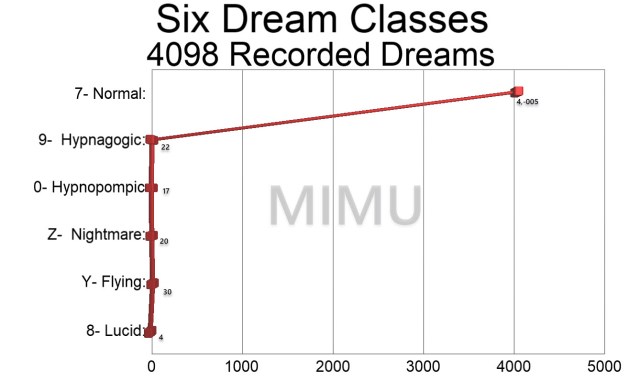
    Below I examine the classification scheme I devised for examining 4,098 of my dreams recorded between 1975 and 2021–forty-six years. The actual number of dreams recorded during this period was 5,096. However, 996 were eliminated from classification because they lacked a clear subject or action predicate. For instance, “I dreamed I was in a park.” has a subject but no action predicate. “Ran from a pack of dogs”, is an action predicate but has no dream subject. (What “park”? when? where?) The action predicate is the most important aspect of my classification scheme. The action predicate is where an emotion is generated and dreams are all about emotion.

    All 4,098 dreams were put into one of six categories:

    Six Categories of Dreams
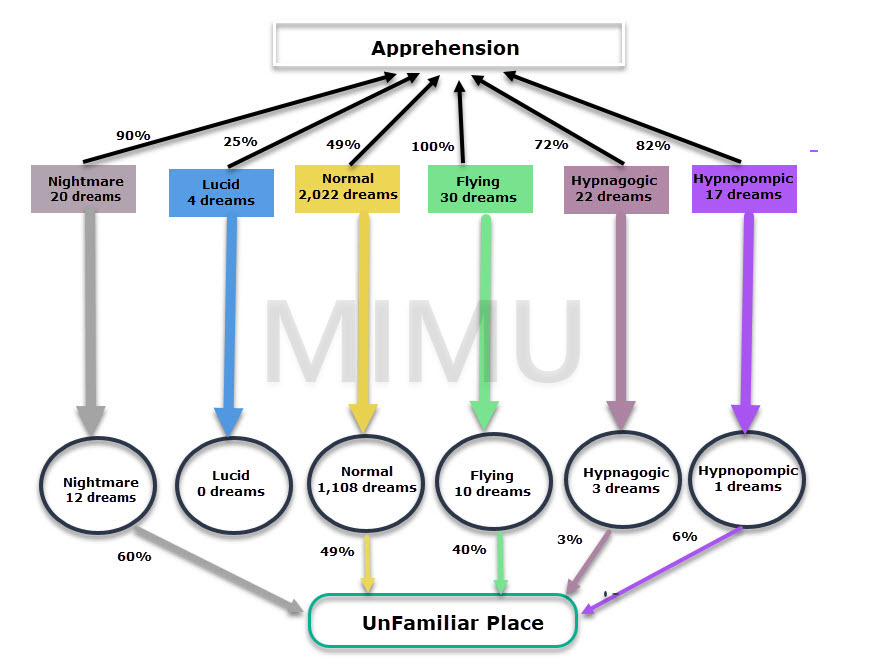
    Normal Dream: 97% (4,005) of the dreams which did not fit into any of the categories below were put into this category. The commonality of normal dreams was subject matter related to places or people in the past which produced emotional reaction more pronounced than in wakefulness. Some 81% of these normal dreams ranged from emotional content of apprehension (which includes fear, anxiety, annoyance and nightmarish aspects) to problem solving to simple observation.  Roughly 13% were either dreams in which I was a spectator or solving a problem. 
     
    Lucid Dream: 0.1% (4) dreams fell into this category though two additional dreams were a close call. Becoming aware of being in a dream while dreaming is more like a thought exercise than a hallucination. It is also supports the idea that sleep is an extension of wakefulness. The only real distinction between the two is the biological state of the body.
     
    Hypnagogic Dream: 0.54% (22) dreams fell into this category. Classifying the state of paralysis experienced before falling asleep and the resultant dream-like sensory overload accompanying the experience may not technically be a dream in the accepted definition.  But like Normal dreams and the hypnopompic state described below, a hypnagogic state is an altered state of consciousness and can be nightmarish or, conversely, inspirational.
     
    Hypnopompic Dream: 0.41% (17) dreams fell into this category. Unlike hypnagoic states, the hypnopompic state is paralysis occurring before falling asleep accompanied by the same dream-like sensory overload–both visual, and more importantly, auditory.
     
    Nightmare Dream: 0.49% (20) dreams fell into this category.  Nightmare classification is based on the criteria that one awakes from a dream with deep fear. The defining criteria is being awakened from sleep.  Like the class of lucid dreams examined here, there were some close calls. In fact, within all six categories, 63% involved some level of fear.  But the fear did not rise to the level of causing sleep arousal.
     
    Flying Dream: 0.73% (30) dreams fell into this category. This category was added in anticipation of the widely held presumption that flying dreams were pervasive and rather common. Another presumption of pervasive dream activity is being chased in a dream, which in this classification scheme is captured under the Emotive Quality of fear.  But like Flying Dreams, dreams of being chased were surprisingly few in my examination.

    When classifying data the objective is clarification. Obviously when 97% of your data falls within one category and your data is dreams, there is not much clarification.

    In November 2018, before I decided to come up with a classification scheme for my dreams I dreamed about coming up with a classification process. At the time I was not really thinking about categories and classes. My focus was on word-tracking associations. In the dream about classification (#3513# recorded in 2012) I was frustrated by how difficult it was to come up with a viable scheme to classify dreams. Was this a predictive dream? Not really. Fitting into the category of Normal dreams, the anxiety dream about classification shared the emotional qualities of apprehension, fear and annoyance common to 63% of all six categories of dreams. For our purposes here, the 4,005 dreams in the Normal category reveals a map into the opaque world of self as an independent agent.

    Answered Questions From Dream Records

    The six categories I used for dream classification clarified and answered a few questions I had about dreams since I began recording them.

    How many times have I had a recurring dream?

    There is a popular belief that we have dreams which recur. In a previous interlude (PART VI) I related the instance of what I thought was the recurring MESSY HOUSE dream. In my case, I found the idea of a recurring dream actually occurred within the dream itself. There were three instances in which my dream-self remembered having the same dream before. A variation of the recurring dream was memory within the dream of being in the same place (a store) before. There was nothing in the dream records to support either a recurring dream or having been in a dream place before despite the conscious belief to the contrary. It is entirely possible the dream element–store or house–occurred in a dream that was not recorded but I have strong doubts about this take.

    Why did so few of my dreams contain spoken language, sometimes a foreign language I did not understand while awake but understood perfectly when dreaming?

    The distinction between spoken words in a dream and simply thoughts being transmitted and received was of special interests. In some dreams I heard words spoken and other sounds. This was unusual for me and, from research by others, is a rare occurrence. Most research involves attempts to determine how external sounds are incorporated into dreams. Little research is available about sound generated from within dreams. If you think about it, carrying on a dream conversation in which you are generating dialog for everyone is the prototype of a hallucination. What about the auto-directed conversations we carry on daily in our heads? Roughly 13% (548 entries) of my dreams contained sounds or spoken words.

    Why do I occasionally hear music in my dreams?

    Like spoken words and other sounds, music was heard in very few (1.8% or 74) dreams. Only in one instance was the music pertinent to the content of the dream. In most of these dreams the music was background sound.

    What was the usual dream context in which I had dreams of flying?

    As J. Allan Hobson points out in his book DREAMING: A Very Short Introduction[17], Sigmund Freud regarded flying dreams as disguised “unconscious” sexual desires. I recorded 97 dreams explicitly involving sexual activity. None involved flying. The popular “dream interpretation” assessment is that flying dreams are moments of spiritual freedom. Of my 30 flying dreams or floating above a scene, all involved moving from point A to B or moving beyond an obstacle or danger of some sort. In one flying dream (#4840) my dream-self willed my body to fly and skim over the top of trees knowing people below were watching in amazement. I suspect that there is a strong biochemical basis for dreams of flying. The same is also most likely true for dreams of falling. Flying are dream events, not emotions. Events generate emotions.

    What is the difference between the paralysis state experienced before sleep (hypnopompic) and after sleep (hypnagogic)?

    For me in both paralytic states the central feature were terror, fear and curiosity. My first recorded hynopompic experience occurred in November 1975 (#4989) and the first hypnagogic experience in November 1993 (#2810). I have always compared these paralysis episodes with the alien abduction narratives reported by author Whitley Strieber (Communion: A True Story by Whitley Strieber18) and especially the alien abduction narratives reported by Raymond E. Fowler in his book The Watchers II19. My paralysis episodes involved all the “intruder” elements of reported abductions–little people whispering incomprehensible words. There were no abductions. After experiencing roughly half of the thirty-nine paralysis episodes, I have come to accept them as alternate states of self-awareness in which profound though not extraordinary psychological effects occur. Reportedly, 6.6%20 of the general population experiences sleep paralysis. Paralysis experience surrounding sleep are undoubtedly organic in origin–determined by bodily chemical and electrical functions. I am convinced these paralysis states are associated with some form of transitory, as in organic, emotional depression. Neuroscience speaks of reduction of reaction time in the frontal lobe. There is no reason to doubt this assessment. But there is more than just a neurobiological based emotional condition involved. Personality traits and personal expectations color both hypnopompic and hypnagogic experiences.

    Dreams as Reality Constructs

    In PART 4, we discussed standing in a line observing a toddler in a parent’s shopping cart. We wondered exactly what the child saw when observing the stranger in front of them. Since the child can not verbalize what they see or feel, you rely on your internal dialog generator to verbalize what the child might be thinking. You do not hallucinate. You use your imagination. Is using your imagination the same as hallucinating? No. Because you, that frontal lobe executive managing memory, controls your imagination, keeps it within rational bounds. You can drop back into the reality of the moment at any time. Observing a silent infant sitting in a shopping cart for instance.

    This seemingly off-topic subject of babies and what they may or may not be thinking at any given moment will pop up again as we define consciousness. Here it is relevant because the situation has a component common to dreams. Like a dream, you encounter a person, the baby, for whom you could create your own dialog. You may ignore the child. If not you may create a brief dialog in your head. You have a life in which reciprocal dialogs do not depend upon your own thoughts. This broadly comes under the jargon of the Theory of Mind–we assume the person we encounter share our own emotional and mental capacities. The key point here however is that you recognize that the baby in the cart could carry on a dialog if they could speak and were so inclined.

    If mature human fetuses (24 weeks and beyond) spend time dreaming, the question is why? Certainly they don’t have taboo unconscious urges requiring symbols to be interpreted. They could be processing and assimilating tactile and sound information from their physical environment. But then this raises an origin question. Which comes first for the fetus: processing or stimulus assimilation?

    Given the amount of time infants sleep and presumably dream, it is not unreasonable to assume that dreams are about the future, not the past. Fetuses, as far as we know, have no pass. Only a future. Our focus on the imagery, mentally constructed tactile sensation in dreams deludes us into believing dreams are about yesterday, the day or years before. Or we hypothesize that dreams are about consolidating memory, rewriting moments of wakefulness in symbolic form. In reality–read that as in the moment– dreams are the scaffolding on which the future of wakefulness are built. The process is a continuum. The real question is how do dreams differ from the stream of thoughts we have while awake. A significant clue lies in the dreams examined.

    The only dreams I had in which there was no element of apprehension, anxiety, fear, anger or annoyance were the four lucid dream experiences. Some level of apprehension or related emotions are such an integral ingredients of dreams that it is impossible to separate the two. Think of the momentary pause you make in crossing a busy street. Or, imagine the experience of a fetus being born into the world of air and tactile sensations. Dreams are the scaffolding on which tomorrows are built, cauldrons distilling what we will be in the future.

    In order for neuroscience to come up with a scientific definition of consciousness as self-awareness, not only for humans but possibly a host of other species, it will be necessary for the science to back away from the blunt electro-biochemical brain model they are currently using. Backup or dig deeper. Maybe dig all the way down to the world of quantum uncertainty. Humans–life itself–may be a biochemical machine but it is a machine running on a fuel of which we are totally unfocused.

    REFERENCES

    * Based on roughly 3,270 records from 2010 to 2021 which is not the entire period covered by the dreams examined.

    # This symbol refers to the record number identifier assigned to an entry in the dreams database and is not a sequence number.

    16. THE WASHINTON POST, February 6, 2022, Carolyn Wike, Copyright 2022, originally published by KNOWABLE MAGAZINE.

    17. DREAMING, A Very Short Introduction, J. Allan Hobson, Oxford University Press, 2002, ISBN 978-0-19-280215-6

    18. Communion: A true Story, Whitley Stieber, Avon, 1987, ISBN: 978-0-380-70388-3

    19. The Watchers II, Raymond E. Fowler, Copyright 1995, Wild Flower Press, P.O. Box 726, Newberg, OR 97132, ISBN 0926524-31-3

    19. Mental Health Daily, https://mentalhealthdaily.com/2015/05/18/hypnopompic-hallucinations-causes-types-treatment/

    20. Zlatev, Jordan, Racine, Timothy P., Sinha, Chris and Itkonen, Esa. “The Shared Mind: Perspectives on Intersubjectivity: Converging Evidence in Language and Communication Research 12”. Cognitive Linguistics Bibliography (CogBib). Berlin, Boston: De Gruyter Mouton, 2010. https://www.degruyter.com/database/COGBIB/entry/cogbib.13335/html. Accessed 2022-02-13.

    Share this:

    • Share on X (Opens in new window) X
    • Share on Facebook (Opens in new window) Facebook
    • Print (Opens in new window) Print
    Like Loading…
    May 24, 2023

  • Part VI: Dreams Classified – An Interlude on the way to a definition

    The Definition of Consciousness
    Me, I, My and Us, the MIMU of Self
    BY LYNARD – JAANUARY, 18, 2022

    What started my search for the definition of consciousness was the question of where dream images originate. The answer would seem rather simple. Neuroscientists and psychiatrists like J. Allan Hobson address dream imagery in the aggregate, as pictures in a hallucinatory, altered conscious experience and a vital part of the conscious awake-state. There is a problem with this approach. The issue of course is the definition of consciousness.

    This interlude is about the classification of dreams and how this alternate state of “consciousness” in which they occur is really not an alternate state at all but, as Hobson rightly points out, a continuation of waking consciousness–both the brain “consciousness” and the mind “consciousness”.

    Until I started classification of the 5,094 dreams I recorded between March 1975 and August 2021 (roughly 16,500 nights of dreaming), I would have given a passing nod to the description of dreams as “hallucinations” occurring between the states of wakefulness and sleep. After all, despite the theory of Sigmund Freud and the symbol books for dream “interpreters”, dreams are only dreams. Emotive adjuncts to daily reality. But after going through slightly more than four thousand dreams (eliminating over a thousand because they did not meet my classification requirements) I have had to elevate dreams from adjuncts of reality to road maps, encompassing past, present and future reality.

    Recording Dreams

    I recorded my first dreams in 1975 in a three-ring notebook. Nineteen years later (1994) a friend gave me an evaluation copy of a computerized DAILY JOURNAL (1.0). I transferred my notebook entries to the computer program. It was slightly less than two hundred entries. The evolution of the WINDOWS operating system made the DAILY JOURNAL program obsolete by 2010. I rewrote the program in 2010, adding features to specifically track words and phrases in addition to sleep times and sleep phases. This tracking methodology–words, phrases–was woefully inadequate for making sense of dreams but I was not to find that out until eleven years later. Transferring the roughly eighteen hundred records from the DAILY JOURNAL program to my TGJOURNAL was a fairly easy automated process.

    Pondering a Dream Classification Scheme

    Later I will go over the dream classification statistics for the roughly four thousand records. I spent six months trying various classification schemes. They all proved inadequate, including the final seven categories and thirty-six categories used. For instance, a dream in which you see yourself chasing yourself –fear as the type dream dose not fully capture the essence of the dream. Then there are a whole class of flying dreams in which flying is the least significant part of the dream. More work is required on the classification scheme but the broad designations have revealed some surprises. These will be covered in the next exploration interlude.

    My daily habit is to wake between five and six, make coffee and record my dreams. I never go back to look at yesterday’s entry, a practice which I apparently shared with Hobson and his record of 300 dreams15. This record-it and leave-it is a highly significant aspect of examining dreams. Previously, the only time I examined entries was when I transferred handwritten entries into the automated DAILY JOURNAL.

    Shock and Thought

    I started paying attention to my dreams when I was around eleven or twelve years old which I think is rather typical. What hooked me were the incredibly rich colors appearing in my dreams. I never recorded these dreams of course. Memory of the intense, vivid colors have stayed with me. My real dream recording did not start until 1975, sporadically, and became a dedicated endeavor while in college and working on a novel which was never published.

    A Hypnagogic Experience

    While in college, I had a dream-like experience which cemented my interest in dreams and consciousness. I will not bore you with a verbatim recitation of dreams, however there are two highlights which I must relate in order to clarify where I am going here.

    One day after returning from my morning classes at college, I laid down to continue reading a biography of Andrew Jackson. Most likely the book was by Marquis James ( I do not know this for sure) since it was a library re-sell book. As I was reading I fell asleep. Or at least, I think I fell asleep.

    Life as A Hallucinatory State

    While asleep, with the biography of Andrew Jackson near my pillow, I read the entire book. There were vivid images of pages of the book as I read through it. I have never read a two or three hundred page book in one sitting. At the time however I had no doubt I had read the Jackson biography while in a sleep state and I considered it very strange and weird. Did I really read the entire book in my sleep? Is it even possible? The easy answer is no. The science based answer is I have no idea.

    This takes me to the second reason for my interest in dreams. Fast forward roughly ten years and I underwent an eye-opening experience related to dreaming.

    FOUNDATION OF A FALSE MEMORY

    In driving south on Interstate 55 one December morning I passed a section of the highway in which huge square section were cut into the left lane roadway and blocked-off by construction barriers. I remember thinking at the time that if a car ran into one of the square holes the car would certainly flip and possibly cause death. Eight hours later, traveling back north and about five miles or so from the highway work area, I see a bright, yellowish explosion of light in the sky ahead. Thoughts running through my head included farmers burning brush–it was a farm area–or my first and only UFO sighting.

    When I finally arrived at the construction area I saw what apparently had happened. A tractor-trailer truck cab was leaning slightly into one of the square holes carved into the left-hand side of the highway. A highway patrolman was waving meager slow-moving traffic forward. I also saw a rather heavyset man, whom I assumed was the truck driver, in a brilliant white T-shirt with his back to me sitting on a guardrail opposite to where the truck-tractor had come to a stop. I drove home without farther incident.

    Four or five days after the incident I awoke from a night of three dreams. In one of those dreams a smaller truck was crushed between two tractor-trailer trucks [record #555] when the lead semi-tractor abruptly stopped. A white car drove by the accident scene and just barely escaped being part of the wreckage. The dream event happened on a city expressway I occasionally drove to and from work. The dream left me apprehensive about driving on expressways. Not frightened, but cautious. Sometime after the dream, I remember mentioning the accident I saw on I-55 to a co-worker. My apprehension about driving on highways and expressways quickly went away afterwards.

    So, first there was the accident. Four or five days later, the dream. Several days later, recounting the general outline of the highway accident to a coworker. The three events seemingly unrelated.

    There was no one Eureka! moment when I finally figured out that one element of my memory of the Interstate-55 accident was a false memory. It was a gradual realization. The clearest and starkest memory of the accident was memory of the truck driver in a white T-shirt sitting on a guardrail. The problem was that the memory image was too clear, too stark. It was very much like one of my dream images.

    Approaching Dream Reality

    There are two ways of approaching this dream. We could go all Freudian and delve into emotional suppression and projection. We could also go all Allan Hobson or Michel Jouvet and view the dream as a coping mechanism for bridging the gap, and possibly the residual adrenaline, between a waking consciousness experience and a sleeping consciousness hallucination. Or, just as reasonably, we could look at the dream as both an emotional and physiological reaction to a traumatic experience resulting in a false memory. The Jackson biography book-reading incident is something slightly different, maybe somewhere between the Freudian and Hobsonian brick road.

    Labeling a memory as a false memory is a very big deal. Saying that the basis of a false memory is buried in the hallucinatory adjunct to reality of dreams may not appear a big deal but it is. And when you delve more deeply into the dream state, we find support for Hobson’s contention that “consciousness” has both an awake and an asleep state. Note that consciousness is in quotes here because we have yet to define it. For now, we will go with Rene Descarte’s “” definition. But if the “I am” can subsist on the basis of “little” false memories derived from a “hallucination”, what does this say about the “I think” of consciousness?

    False Reality as Reality

    During all the time I was recording my dreams I thought the majority of those dreams were centered around train travel and a recurring visit to a large, leaky house.

    After going through over four thousand dreams I was surprised to find that what I thought was a recurring dream was in fact not a recurring dream but rather variations on a recurring theme tied to an illusionary house.

    Recurring Dreams, False Reality

    Instead of recurring dreams, what I found was that the idea of a recurring dream can occur within the dream itself. A cousin of the dream generated false-memory with just as powerful an effect.

    I once had a dream (#998 record, 2011) in which, in the dream itself, I thought I had repeatedly been in a very large, multi-storied house with a leaky roof and very messy rooms. The house dream was one of those clear, vivid dreams requiring no effort to remember. A memory occurring within a dream is rare. Even rarer is a feeling of something having happened before (a deja vu experience) in a dream, but I have had two such dreams and assume others have as well.

    RECORD DATE LEAKING ROOF CONTEXT
    #31801-13-1998            Inspect holes in tin covering condo roof leak
      #85 10-22-1998          Raining and roof leaking
    #998*05-30-2011       Tour multi-story LARGE MESSY HOUSE* with leaking roof
    #178111-21-2011           Renovated one story house with leaky roof
    #208109-23-2012       Notice water had leaked around a soffit
    #213711-18-2012         Outside a large house with leaky roof covered with snow and ice.
    #244209-12-2013       water damage to foundation of large house because of leaky roof.
    #2734*07-07-2014    Dreamed awoke with water on floor reminded me of LARGE MESSY                                                             HOUSE  dream. Leak from roof.
    #2856* 10-25-2014   Working to rehab house with leak in roof and water in basement. Same                                                      house as #998
    #3266*11-03-2015     Familiar house with leaky roof. Water on bathroom floor from shower,                                                       bathtub.
    #3559*04-16-2016    Emptying room in MESSY HOUSE in preparation for sale. Attention called                                                 to sand covering the floor.

    What I thought was a recurring dream, #998, first occurred in May 1998, approximately three-and-a-half years after I experienced a leaking roof in my condo (between 1996 and 1997). The MESSY HOUSE theme occurred in four more dreams (#2734-#3559). There was no repeat of the #998 dream itself. This recurring dream theme has a beginning, middle and end.

    I have never been in such a large house with a leaky roof. However, fifteen years before the leaky house dream I experienced a leaking roof in my small condo and had to take corrective action. The first leaking roof dream occurred two years later (#318 record 1998), followed by another dream nine months later (#85). Neither of these dreams involved a large house nor a house that belonged to me. No other leaking-roof dreams occurred until twelve years later. By the time of the large house dream when my dream-self remembered being in the house before, my walking conscious was prepared to accept the conclusion that any dream involving a leaking roof was about the large house.

    Dream sequences such as the MESSY HOUSE dreams make us susceptible to the belief that dreams are filled with symbols and conceal significant insights into our waking life. The dreams are “logical” and seem to reflect an obscure reality that, if only we could interpret them correctly, they would reveal something of earthshaking importance.

    I could trace my erroneous belief that “most” of my dreams concern train travel to a similar sequence of dreams in which I remember dreaming of being on trains. The dynamic mechanism resulting in the MESSY HOUSE fixation is most likely the same for trains. And there are other examples.

    How connected are our dream memories and the memories we walk around with defining who we are?

    The Reality Dream Continuum

    In J. Allan Hobson’s CONSCIOUS STATES he posits that dreams are an interruption of wakefulness generated by biochemical activity of body and brain, resulting in the hallucination of dreams. A more logical and scientific argument might be that being awake is an interruption of sleep and dreaming. But then, this raises the question of whether life in the womb started out as us sleeping or awake.

    Hobson is correct in viewing the continuum of wakefulness and sleep, and additionally dreams. Confusion is introduced into his excellent exposition into waking and dreams when he uses the term “consciousness”. Acknowledging that the “hard problem”–the self being aware of self– is an issue he, like neurologists in general, to ignore because it seems insolvable.

    The Boxy Problem of the “hard problem”

    In simplest terms, qualia is the ability of the human mind to perceive itself as a perceiver of a mind. Yeah, sounds like a box of assorted chocolates where you can drop in concepts like God and gods, ESP, ectoplasm and my personal favorite, electromagnetic waves from superior alien beings. Mysticism, spiritualism, parapsychology are all disciplines in which the hard problem are not only addressed but solved. Science has pretty much declared the problem currently beyond its capacity to address. Hobson follows the science, thus “consciousness” is defined simply as life beyond the life-path of an ameba. I have a different take. Science has already solved the problem of qualia.

    Consciousness As Life

    For neuroscientists, consciousness is a state of the brain producing a mind. Animals go from wakefulness, to drowsiness to sleep, all measured by the amplitude of brain waves. If we use brain state as defining consciousness then all animals with a brain are conscious. That would include dogs, cats, monkeys, birds–the usual zoo. All are endowed with this state-of-life consciousness. It includes dreaming.

    The Three Worlds of Reality

    We know from observations aided by technology that mature human fetuses, at around twenty-three or twenty-four weeks, display brain wave indicators of dreaming. Are fetuses assimilating events of the day? And before you question exactly what events a fetus would have to assimilate, think what it would be like to live inside a vibrant body encased in 27 to 20 ounces of amniotic fluid where sounds and motions are easily transmitted. An even more pressing question is whether dreaming came first or the capability to respond to stimulus and assimilate that stimulus came first. Either way, the fetus is living in a strange, isolated world where “hallucinations” constitutes a reality. Let’s call this the First World.

    The fetus enters the Second World the moment they are born. It is very doubtful the fetus could have dreamed a more traumatic hallucination than being exposed to air. The Third and final World is when the infant is first touched.

    First World existence can last from as few as ten days (opossums) to as long as ninety-five weeks (African Elephants). Second World is as experience can last minutes to hours throughout the animal kingdom because nature has apparently perfected the method. Third World experience can last as short as one year (house mouse) and as long as 500 years (sharks). It is in the Third World experience that humans deviate from the rest of the mammal kingdom.

    A house mouse for example, with a life span of one year, is dependent upon their mother for 21 days and reaches sexual maturity in around 35 days. At the age of around six weeks, they begin mating. Humans are very dependent upon their mothers for the first six years of life and do not reach sexual maturity until twelve and twelve -and-a-half years. Why can a mouse mature in twenty-one days and a child takes twelve years? One way to look at this is to consider that the only thing a mouse has to learn to survive in life is to walk in search of food and pee at the same time while a child has to learn to stand and balance, process a plethora of vocal sounds, and recognize a parked car from a speeding car.

    Science and Philosophy Consensus

    There is nothing here for neuroscientists, philosophers and dream-interpreters to quibble over. All animals undergo a period of incubation, birth and then first breath. (Marine mammals are a slightly different story of course). But once in the Third World, humans take a drastically different course of development

    The upshot of all this, when it comes to dreaming and wakefulness, is that it is impossible to define consciousness unless the entity–human or animal–is present in the Third World. This is the first clue to what constitutes the qualia of consciousness and you would think it would be the starting point for neuroscientists in connecting brain and mind. But there is a conundrum here. It is a variation of Austrian physicist Erwin Schrödinger’s cat in a box thought experiment.

    The Ten Second Reality Switch

    And for dream researchers in particular, while some assume a long dream and a short dream are related to the amount of time slept, the two elements appear to be unrelated. The reality is that the sixty to ninety minutes we spend in Rapid Eye Movement (REM) sleep manifests as a dream only within the ten to twenty seconds it takes for us to become fully awake. Memory is not available to record a dream as it occurs. Thus, dreams are fleeting and most of us do not remember them consistently. More importantly, memory of a dream can be distorted in any number of ways. The sleeping and waking cycle itself occurring during the night can distort a dream and not to mention the sound of an alarm clock or a burst of music.

    Final Word

    This is a long interlude toward defining consciousness. But just about everyone who tackles the definition of consciousness start with dreams. The reason is the contrast: dreaming is regarded as an alternate state of consciousness where the individual is “out of this world”. Science can argue legitimately that the chemical and bio-electrical activity of the brain starts twenty to twenty-five weeks after conception and continues to death. Between is this curious alternate state of sleep and dreams. Biologically related. But separate from “consciousness”. Intuitively, we reject this notion

    Right now, if it were possible for you to slow your thoughts, that voice racing through you head, and you lost the ability to remember the moment to moment transition of time, you would in fact be dreaming. Until you read THIS!

    Our dreams are part of our lives and we claim ownership of them just as we claim ownership of our internal voice. Part of a continuum. It is one of the reasons we consult dream “symbols” and regard them as revealing “unconscious” thought-threads shaping our perspective of “reality”. We even look for hints of the future in our dreams.

    In the final interlude toward defining consciousness, I will present the classification of my dreams.

    REFERENCES:

    1. Conscious States: The AIM Model of Waking, Sleeping, and Dreaming, pg 151, Copyright 2017. Hobson, Allan, edited: Nicholas Tranquillo, Anthony K. Shin, 288 pages, ISBN: 154669756X. See page 151.

    © Lynard Barnes, 2020
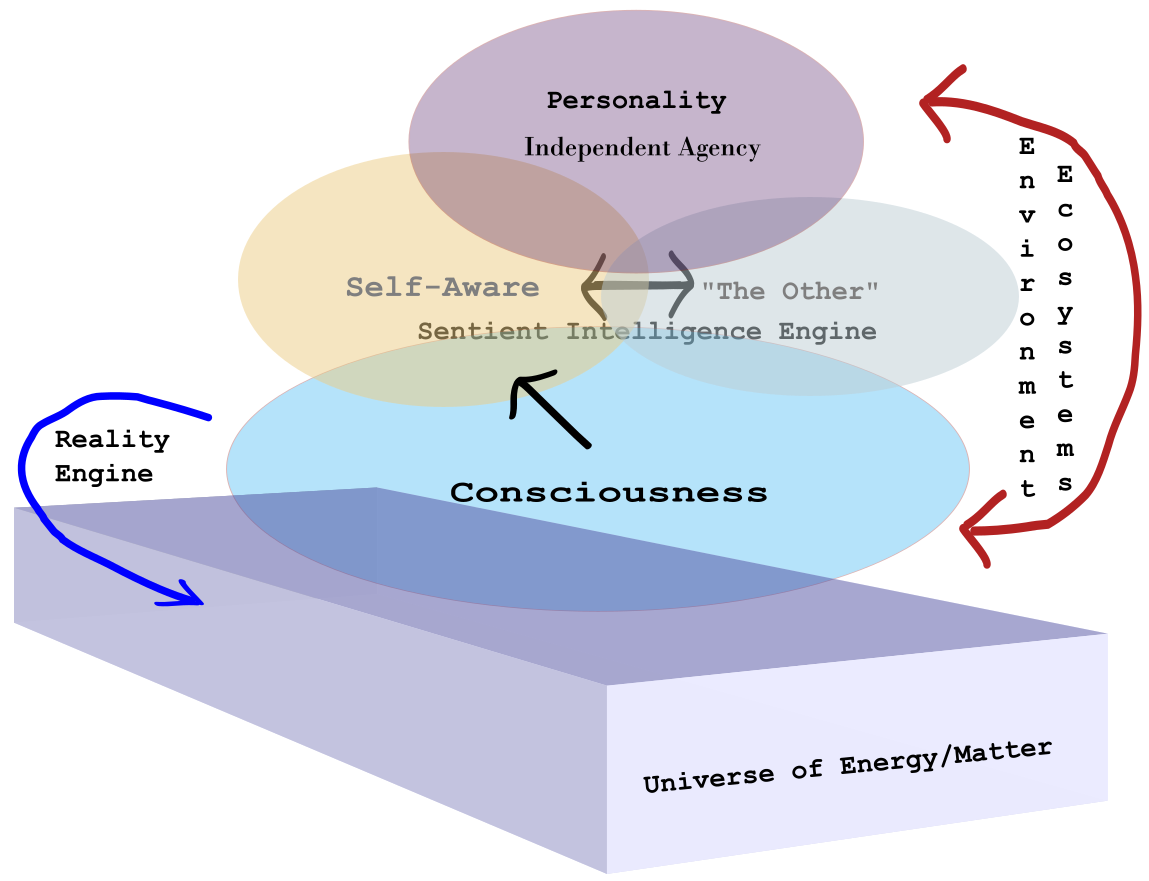
    Share this:

    • Share on X (Opens in new window) X
    • Share on Facebook (Opens in new window) Facebook
    • Print (Opens in new window) Print
    Like Loading…
    May 24, 2023

  • Part V: An Interlude on the way to a definition

    The Definition of Consciousness
    Me, I, My and Us, the MIMU of Self
    BY LYNARD – SEPTEMBER 2021

    On your journey to finding a definition of consciousness you should read Allan Hobson’s Conscious States: The AIM Model of Walking, Sleeping, and Dreaming . Before doing that however, consider the following science.

    Hobson adheres to a scientific approach to defining consciousness. A scientific definition of consciousness by examining the brain for states of consciousness. Except in one instance, he jumps completely out of the scientific approach. In our effort here, w e endeavor to adhere to the scientific method on the way to defining consciousness. So, it was a bit of a shock when we encountered a very unscientific declarations by Hobson in his otherwise excellent and highly informative book.

    According to Encyclopaedia Britannica Homo Sapiens (“wise man”) is either 195,000 years old or 315,000 years old. During this time frame, according to anthropologists, the human brain has been about the same size for roughly 200,000 years, comprising 1.5 kilograms (about 3 pounds and 5 ounces) of adult body weight. Keep these scientific observations in mind as your read Hobson’s excellent exploration of the states of consciousness. And for the rest of your pursuit of a definition of consciousness, ponder the fact that human-kind, with the same brain, went from confabs around camp fires (possibly started by lightening) to landing a human on the moon in 200,000 years. Sure, the laer is rocket science, but 200,000 years? If the brain is the originator of consciousness–Decartes “I think, therefore I am”–why did it take 200,000 years for humans to reach for the moon? A question to be answered on our pursuit of a definition of consciousness.

    If you want to get a rise out of scientists, point out the parallels between science and religion. The foundations of all modern western religions– Judaism, Christianity, Islam–can be traced back to Assyria, an empire occupying the “four corners” of the Mesopotamia world some four to five thousand years ago. (The basic tenets of these religions most likely go back much, much farther, perhaps all the way back to 200,000 years when lightening came from the sky).

    Religion offers a rational, belief-based (faith) system appropriate for explaining everything under the sun. Along comes the recently enshrined scientific method–an empirical protocol for acquiring knowledge. There were plenty of scientists around before Copernicus and Newton and Galileo, but the scientific method is a relatively new approach to explaining everything. Experimentation and repeated validation. A blue-print method for evaluating everything under the sun. The key words here are exploration and evaluation, not explanation. But scientists, being scientists and human, sometimes are reluctant to use the four words that ultimately define the human condition: “I do not know.” For instance:

    Me Myself and the Ocean Blue

    Imagine you walk along a pristine ocean beach. From the sand, you pick up a single grain of sand, take a few steps into the water and drop the grain into the water.

    Going all science on this beach stroll and seemingly causal event, we know the following.

    *** 1 ***

    The beach is composed of trillions of grains of sand and you have taken one grain away and tossed it into the ocean depths–or maybe just into the water to possibly have it washed ashore again. Based on a little probabilistic math, we can get a reasonable approximation as to the fate of the grain of sand. But the fact is we do not know with certainty where that grain of sand ends up. That is why we can say we can–if so inclined–make a probabilistic determination of where the grain of sand ends up.

    *** 2 ***

    We know the beach is minus at least one grain of sand and that the grain is somewhere in transit in the ocean–on its way to the bottom, being pushed ashore or out into the ocean. This knowledge however is conditional. We also know that the ocean is continually depositing grains of sand on the beach so this “minus-one-grain” of sand is not an absolute certainty.

    Now, consider the things we do not know.

    *** (a) ***

    How many grains of sands are on the beach at the moment the one grain of sand is removed. We could build a machine that counts all the sand grains laying on the beach, going all the way down to bedrock. At the moment however, we do not have such a machine.

    *** (b) ***

    How many grains of sand are being deposited by the ocean or being removed by the ocean at the time you transport one grain of sand into the ocean.

    Being scientists we know we can devise a means to count the number of grains of sands on the beach and determine with precision where the grain of sand ends up once in the ocean. We know we can do that. (After all, we did send a man to the moon).

    As scientists, with logical constructs for every possible activity, both human and none human, we might pause to consider what exactly is to be gained by counting the number of grains of sand on a beach.

    Are We There Yet

    Now, let’s say the beach is the human population of the world. The grain of sand then becomes an individual who dies and the ocean is symbolic of the Great Unknown. To simplify, a member of the population dies and disappears into the nothingness of the Great Unknown. Now, what do we know.

    *** (A) ***

    The death of a life is entropy–organized energy dis-organizing. The physics of the universe is the stroller on the beach, moving a life from one state to another. Life to death.

    *** (B) ***

    We know there was once an individual with consciousness, a life force. That individual is no longer conscious and is now physically disintegrating to eventually return to dust. The life-force–breathing, walking, talking, expressing emotions and thoughts–has disappeared from our life spot on what we assume is the beach of life. Are we the beach? We must be because we remember a missing life, like a beach missing a grain of sand.

    Now, for what we can scientifically say that we do not know

    *** (1) ***

    A life-force is born into the world. It is already a life-force when born but is not “acclimated” to the life around it. We do not know whether what we call consciousness is present before (biologically determined) or is an acquired attribute after birth (biologically and socially determined). With the incredible magnitude of bio-electrochemical activity of the brain, even before birth, it is more than possible that what we call consciousness starts before birth. But that is pure, speculative conjecture.

    *** (2) ***

    What happens to the dead individual’s consciousness–the signals emanating from the life-force. For a grain of sand, this is mass, a tiny electromagnetic force. For an individual, it is the biochemical-electrochemical activity of the individual. An empty spot on the beach, the absence of a life-force. We know that there are traces of the life-force present in those on the edges of the beach–memories of the individual– but the individual has disintegrated into the Great Unknown.

    For the punch lines, consider these statements.

    (Q1) The grain of sand tossed into the ocean no longer exists .

    Is this true or false? If we follow the science, this is obviously false. Physical matter just does not disappear into non-existence. It can change into different matter or become energy, but it definitely does not simply cease to exist.

    (Q2) When a human dies, physicality, physical form ceases to exist.

    Is this true or false? If we follow the science, this is obviously true.

    (Q3) Physically the deceased individual no longer exists. The life-force of their personality, their expression of consciousness ceases to exist. (Note that “consciousness” is really not defined here. We are merely designating physical attributes of life as “life-force” to include observably human behavior ).

    This may be true or false. From a purely empirical standpoint, we simply do not know. It is really a number-of-grains-of-sand on the beach question. Even if the deceased is an infant who lived only an hour, they have left traces of their physical selves all over the beach and, if we had the tools to measure, even their bio-electrochemical footprints might be able to be traced to their absence. From the religious perspective of faith, of course, the statement is a simple false.

    The Leap Beyond Science

    When a scientist like Allan Hobson says that “At the moment of death, our consciousness fades forever”, we must take this as pure speculation even if we accept the brain as the progenitor of consciousness. There is nothing wrong with speculation nor accepting speculation as the corner-stone of a discipline of one area of science. But at some point we must stop and ask when does a consistent and coherent idea based on speculation differ from simple faith. This is then obviously followed by the question of whether it matters.

    An Interlude in the Interlude

    While I do not accept Hobson’s assessment of what happens to human consciousness at death–I have no evidence pointing to its cessation or continuance–nor can I accept his more fundamental contention that the brain is the generating hub of human consciousness. But Hobson wraps up the science of the brain-mind-consciousness conundrum in a uniquely comprehensive manner that no other scientist has managed to achieve. He achieves this enviable feat by adhering consistently to the brain as the seat of consciousness–a biochemical, electro-mechanical machine that responds both to itself and the external world. Note carefully that Hobson describes ‘conscious states’, not consciousness itself. There is a good reason for this.

    A definition of consciousness must encompass the foundation of the hard problem. That foundation is qualia which is how we as individuals experience the world and the workings of our own brains. Hobson’s implied definition of consciousness seems to be careening toward the monkey-and-brain conundrum. This conundrum essentially is the science based (statistical) hypothesis that if you placed a thousand monkeys in a room with typewriters they would eventually produce a Shakespearean play. But, back up a moment. In fact, go back to the “beach”.

    Monkeys have brains. So too do armadillos. Better still, elephants have brains. If we use Hobson’s working definition of consciousness, all these animals are conscious. The question however is whether these animals are aware of the animal beach? Maybe they are. Maybe they are not. The simple answer is that we do not know.

    Hobson was a psychiatrist and died in July 2021. In the next interlude on this track toward a definition of consciousness, I will reference Hobson’s DREAMING: A Very Short Introduction. Like Conscious States: The AIM Model of Walking, Sleeping, and Dreaming, dreaming is an important and unique perspective on the subject that started my quest to define consciousness.

    As I pointed out in A Short History of Memory, I wanted to find out where dream images come from. I think the answer is pivotal in definding human consciousness. The reason there is this pause in my quest to define consciousness is because I am trying to classify the four-thousand plus dreams I have recorded over the last forty-years. Spoiler-alert: there is nothing other-worldly about dreams. And to deflate one recently floated idea that dreams are influenced by a full-moon, of the four thousand of my dreams I have examined, finding 112 occurring on the date of a full moon, I could not find any significant difference in content of dreams occurring two, five, ten or greater days after and before a full-moon. I will have more to say on this in my next interlude to definding consciousness.

    Finally, I should point out my faith-based position on human death.

    I believe in reincarnation–the belief that I have lived before–and have believed such since I was around nine. There is absolutely no scientific, empirical evidence supporting re-incarnation. If reincarnation was a real thing, you would think that in 200,000 years there would some proof, some validation of the belief somewhere in the human experience. I have not found it.

    While the belief does not dictate my ethical conduct, it does effect my approach to such questions as definding consciousness. It is a faith-based belief as opposed to an empirical conclusion. Do I need empirical evidence? It is not a rhetorical question.

    In the next interlude in pursuit of a definition of consciousness, we take a look at dreams and we will get closer to answering the two significant questions asked here: why, with a brain that has not changed significant in 200,000 years, has humankind discovered the novelty of space exploration with rockets, and where exactly is this line between empirical evidence–the scientific method–and the mysticism of faith. Yes, we are about to get into trouble.

    © Lynard Barnes, 2020

    Share this:

    • Share on X (Opens in new window) X
    • Share on Facebook (Opens in new window) Facebook
    • Print (Opens in new window) Print
    Like Loading…
    May 24, 2023

  • Part IV: Falling Trees and Crying Babies

    Me, I, My and Us, the MIMU of Self
    BY LYNARD – SEPTEMBER 2021

    Life begins with the first breath. Consciousness begins with the first touch.

    Before the plague (that would be the covid-19 virus), did you ever stand in line in a supermarket behind a parent with a one or two year old, a near-toddler on the verge of walking, strapped in the child seat of a grocery cart?

    Beyond the usual “what a cute kid”, and “what a lovely child”, and other exercises of social etiquette, there is an opportunity to learn something very significant about human consciousness here.

    When a Stare is just a Stare

    While you are engaged in the neighborly ritual of praising a relatively new life, you might have noticed the child’s eyes staring at you for a socially unacceptable amount of time. The child glances away, focus again and, maybe, ends with a smile or quizzical frown before finally turning away again to gaze at a parent or bag of potato chips. Of course your natural reaction is to assume the child finds you fascinating, amusing, engaging. It must be you. The toddler has not yet acquired the attribute of three dimensional vision so he or she sees you as a flat, two dimensional interruption of the scenery which may make you more interesting than you might otherwise be. Of interest nonetheless. You however, perceiving child and cart in three dimension, may not be one-hundred percent focused on what you are seeing. Hence, you miss the opportunity to learn something about consciousness.

    This bundle of life staring at you is in the biologically necessitated process of shedding some of the trillions of neurons developed before birth. While in the womb, this child was developing neurons at roughly the rate of 5,000 per second. That’s five-thousand per second.

    At birth there were about 2,500 connecting synapses between these neurons. By the time the toddler is sitting in a grocery cart with a laser-stare directed at you, the number of neurons has gone down from the billions to the hundred of millions, with 15,000 connecting synapses between those remaining neurons. As the toddler ages, synapses connections will continue to grow. The expansion will continue until the bundle of joy attains the age of twenty-five or so and is carrying around about 120 billion neurons. It all sounds very computerese. Normal, predictable biology at work. A good place to start a science based discussion of human consciousness. But, of course there is “hard” science and there is “soft” science.

    Hard science pretty much says that the amount of work nature (mother? god? or otherwise?) puts into developing the brain is truly extraordinary. It goes far beyond anything current human ingenuity is capable of designing or building. Not to belabor the point but to build a computer capable of emulating the human brain, which functions on a measly 3 volts of electricity, would require that computer to have the power capacity of a medium sized city just to power up. Before that goes to your head, humans are not unique in brain complexity or descriptively high-output relative to brain power consumption. Naturally–that is scientifically–it can safely be assumed that the three pounds of brain matter in our heads is the origin of consciousness–the “I” aware of “am”.

    Humans excel in frontal lobe brain development. Other animals not so much. The frontal lobe is the executive area of the brain where all evaluative and autonomous activities of the brain merge in either function or oversight. The oversight part may be a bit exaggerated. The involuntary and reflexive areas of the brain are designed to be just that, involuntary and reflexive though there is evidence that the systems are not completely free of executive controls. Which brings us back to the toddler’s delightful although nerve-racking stare.

    The toddler’s stare just might fit into the soft science category labeled the scopic (staring) drive. (Yes, in some areas of science, staring is a “drive”). Might. But let’s back up a moment.

    Loopholes in the Sciences

    The two philosophical paths leading toward a definition of consciousness are generally labeled substance dualism and property dualism. It is grouped under the heading: the mind-body problem. We can classify the substance dualism approach as cloaked in soft-science and tracks quite nicely with Rene Descartes’ “I think, therefore I am”. Property dualism on the other hand acknowledges the hard science but advocates mental properties as co-existent and equal to the physical. A very good web article on substance dualism is by Howard Robinson in The Standford Encyclopedia11. More specific to our purpose here, Paul Richard Blum’s Chapter 1: Substance Dualism in Descartes published by the Rebus Community 12 .

    Essentially, substance dualism is the belief that the brain and mind originate from different “substances”. Property dualism, the hard science approach combined with a “mystical” off-ramp, is the belief that the mind–thoughts, emotions, memory experiences–emanate from the brain but may not be solely due to properties or attributes of the brain: a physical property and a mental property.

    The question is what does substance and property dualism have to do with a definition of consciousness. The answer in short is nothing. The concepts are merely the foam floating atop what ultimately is consciousness. Though it may be difficult to imagine a conscious being without a “mind”, the problem is defining a “mind”. So, if we can define consciousness, we will be well on our way to defining the “mind”–which may fall into neither the substance or property dualism approach. There is always quantum mechanics where hard and soft science rests comfortably together and we can move beyond the basic mind-body problem. There is only the physics of quantum particles.

    Quantum mechanics, specifically quantum particle physics, has a few lessons for both the soft and hard science of defining the mind and, to a lesser extent, for defining consciousness. In the hierarchy of the real world, the mind is elementary. Consciousness is of a higher order.

    The Standard Model of Elementary Particle physics, The physical world also includes our brains and frontal lobes. From quarks, to protons and neutrons and then the nucleus of atoms and their electrons resulting in molecules pushing against the Higgs Field (defining mass for everything), underpinning a cauldron of biochemical and bio-electrical activity, we eventually wind up at the frontal lobe–the front door of consciousness. It is appealing because it is scientific and essentially predictive. Well, almost.

    The property dualism approach to the mind and consciousness concedes that there is an unknowable hovering over the definition of the mind. A physical property and a “mental” property where one may be more a determinate in the independent agency of the human experience than the other. Again, the mind-body problem. Is it biology or beyond physics? Like quantum mechanics, which has yet to fit gravity into its picture of the physical world, there is no explanation for the independent agency of minds–the “I” part of “I am”.

    John R. Serale, in his excellent essay Why I am not a Property Dualist13, provides a thoroughly clarifying take on the entire body-mind problem. In the essay, he says:

     “I want to say consciousness is a mental and therefore biological and therefore physical feature of the brain.
    

    He wanted to say it. He said it. And then he clarified why the statement does not seem clarifying. Like the baby sitting in the grocery store cart not being able to fully appreciate the three-dimensional world around them, we may all be missing something about consciousness.

    You may have noticed, while staring back at the toddler in the grocery cart baby seat, that the child never mentioned “I’ during their staring seizure. Of course the toddler is not at the age of speaking yet. But still . . . what’s so difficult about saying “I think”, let alone, “I”. There is some hard science with a quantum mechanics twists that helps address this.

    In 2013, an article by Paul Gabrielsen on the ScienceMag website titled (When Does Your Baby Become Conscious?, April 2013)14 reported on research done by cognitive neuroscientist Sid Kouider of CNRS (the French national research agency). A child as young as 5 months old shows brain activity reflecting an ability to be aware of stimuli (called event related potentials or ERPs) flashed before their eyes for a fraction of a second. In an adult, the entire process–from ERP to the brain’s first response to the final “late slow wave” response–takes place in less than a third of a second. In the eighty infants not “squirmy” enough for the test to be conducted, Kouider found the same results, except the response times in the babies were slower. It is a rather controversial finding. What makes it controversial is that the recorded prefrontal lobe activity after the event was over indicates that short term memory was involved. For neuroscientists, conscious thought activity requires the involvement of short term memory.

    A five month old baby exhibits brain activity indicating a reaction to the environment. Under normal circumstances, a “duh” moment if ever there was one. But if the implications of quantum mechanics teaches us anything it is that there is no such thing as a “duh” moment in real science. It’s just another moment with a question.

    Back to the Baby

    So, the baby in the grocery store shopping cart is definitely seeing something. It may or may not be you. And the stare just may be a result of an attempt at confirmation that there is something to see–without or without the scopic drive (scopophilia according to Sigmund Freud). We can rightly assume that whatever the toddler sees is being absorbed into short term memory and may blend into other stimuli and sensations which may work itself into long term memory. It is in the murky empyrean of long term memory that the “am” of “I am” is born. The start of consciousness.

    The acceptance of short term memory as a prerequisite for “consciousness” is a no-brainer. But short term memory is not a definition of consciousness. Then again, even rats have short term memory. They even have episodic memory (the ability to recall events in context), so long term memory is not a definition of consciousness either. Both types of memory are merely attributes of consciousness. (Does this mean that rats, with their capacity for short and long term memory, also have the underpinnings of consciousness? A very important question that really goes to the essence of a definition of consciousness. We will get back to this).

    If you could step back far enough from the scene of you noticing the baby in the cart and all the rest, you would become aware of something rather amazing. You would see a collective mind. But of course, since you are part of the collective, you really do not have an objective perspective. And here is where the body-mind problem becomes a mind-perspective problem. Our mind. Our perspective. Not my mind or your mind. Not my perspective nor your perspective. Our mind. Our perspective.

    I think therefore you are.

    Sentience: the subjective experience of “what it is like” to be yourself, to experience a sensation, or to do an act. Qualia: the unique experience of “redness” when I see a red object.

    © Lynard Barnes, 2020

    Share this:

    • Share on X (Opens in new window) X
    • Share on Facebook (Opens in new window) Facebook
    • Print (Opens in new window) Print
    Like Loading…
    May 24, 2023

Next Page

Website Powered by WordPress.com.


Loading Comments...
 

    • Subscribe Subscribed
      • Barnesfolio
      • Already have a WordPress.com account? Log in now.
      • Barnesfolio
      • Subscribe Subscribed
      • Sign up
      • Log in
      • Report this content
      • View site in Reader
      • Manage subscriptions
      • Collapse this bar
    %d