The Definition of Consciousness
Me, I, My and Us, the MIMU of Self
BY LYNARD – MAY 2022
There cannot be a you without me. And vice-versa.
As to why you are here, you are here because I am here.
There. We quickly got this conundrum out of the way. Or, in a term used in the Bantu language, Ubuntu which can be translated as “I am because we are”, the definition of consciousness with the appearance of independent agency is explained. Humanity.
Distinction of Consciousness
In a delightful series of science fiction novels by Brandon Q. Morris, we can travel along with a character named Marchenko as he rumps through the universe. Marchenko has the ability to transfer his “consciousness” and personality from one body or life-from to another. Perhaps responding to the rumblings from certain quarters, Morris’s highly entertaining and informative latest work, THE DISTURBANCE, not featuring Marchenko except in passing, has one of his characters refine exactly what “consciousness” means.
A character in THE DISTURBANCE makes the distinction between consciousness and self-awareness. We note that this is a distinction missing a critical element, otherwise it would be a distinction without a real difference since there is no self-awareness without consciousness. Consciousness, the capacity and drive to sustain life, can be transferred to another similar life form. Self-awareness–the perception of independent agency–cannot be transferred . Good start. Then we learn that the life-forms into which consciousness has been transferred includes the transfer of personality. This issue of “personality” looms above consciousness and self awareness as underlying the philosophical and scientific definition of consciousness. We resolves this seemingly intractable issue a bit later.
If you want to be entertained while at the same time learning everything there is to know about the definition of consciousness read Robert Lanza and Nancy Kress’s novel Observer. The main theme of the novel starkly clarifies the difference between consciousness and personality. Perhaps more importantly it highlights the mythological dragon in the room when discussing human consciousness: religion. While you will receive a complete and thorough definition of consciousness, you will also encounter the Marchenko “personality” bloat.
Can We Agree
Consciousness, as in self-awareness and independent-agency, is intangible but binary, not thing-like and scalable. An entity is conscious or it is not. Make note of this because we just may say the opposite later.
Personality, synonymous with ”character”, is derived from self-awareness. Personality arises from interaction with “the other”. Life forms we are aware of experience anxiety or fear when initially encountering “the other”. The moment of consciousness (birth) starts the process of “the other” encounter and self-awareness. Personality or character is a scalable attribute of consciousness and is in part or wholly attributable to the anxiety of encountering “the other’.
It is very important that we understand the meaning of “the other”. One simple way to do this is to realize that “the other” is every thing or every one that is not self. Personality, arising from consciousness and interaction with “the other” requires the scalable attribute of intelligence. Pause here and consider what this means.
Under this criteria, dogs, cats, falcons, insects and possibly any life-form we encounter is imbued with consciousness. Activity, life, interaction with the environment, actions and reactions within an ecosystem. This manifestation of consciousness all leads to personality. The demarcation between recognizing the consciousness of yourself and that of a rat for instance occurs on the scalable line we call intelligence. Intelligence being a murky adjunct and sub-set of personality. Intelligence is more appropriately described as the sentient intelligence engine. What a dog, cat or rat might call it is beyond us.
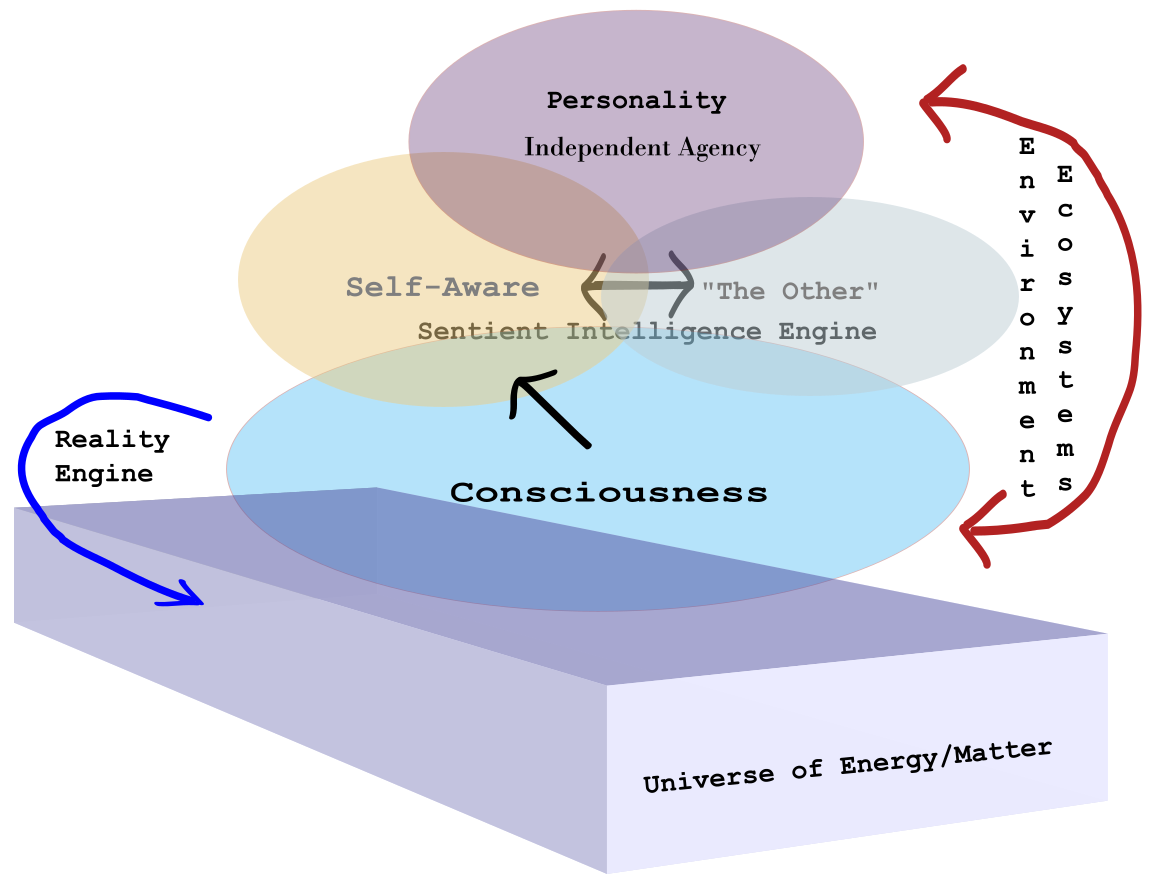
Figure 9-1: The two foundational tiers of consciousness giving rise to “personality”. This is a definitive definition of all conscious life forms of which we are aware.
If all creatures are conscious and all creatures have some form of intelligence, why are you, as a human individual, unique and special?
We humans are part of the same ecosystem we ourselves create. In other words, we share a sentient intelligence engine within the same ecosystem. It is the entirety of these attributes of existence that defines consciousness.
So, if consciousness is a shared sentient intelligence (engine–actions-reactions) within the same ecosystem–does that mean that artificial-intelligent computers are capable of consciousness? We answer that question with another question: is an artificial-intelligence capable of perceiving independent-agency? Or more precisely, can an AI computer develop a personality?
Hal, Are You Listening
The perception of independent-agency is fundamental to personality. In turn, personality is an outgrowth of self-awareness (interaction with “the other”) which rests upon consciousness.
You are not me.
I am not you.
We agree.
Consciousness.
Repeat
Personality emerges from self-awareness. Self-awareness results from interaction with the environment inhabited by “the other”. What does interaction with the environment mean? It means to be acted upon and act on the environment. This action and reaction occurs within the realm of physicality.
I see a bird.
The bird is not me.
Because I was once attacked by a bird, I hate birds.
I run away and leave the bird to its habitat.
Action. Reaction. Action. An endless cycle of life. Yes, some of it is silly and illogical.
An artificial intelligence (AI) may go through the same process.
AI sees a bird. (Action)
The bird is recognized by the AI as not the AI itself. (Wait. Why does the AI reach such an assumption? Upon what empirical or experimental experience does it arrive at the conclusion that it is not the bird? Could be that it was programmed to recognize the bird as something external to itself which would be more a programed reflex rather than a reaction. We withhold judgment on this question for the moment).
The AI zaps the bird with a high-power laser because the bird does not belong in the AI’s habitat. Or, the AI could shoot out hundreds of bread crumbs to feed the bird. Or, the AI could do what most humans would do, simply note the presence of the bird and then move on to reflecting upon its power supply–the equivalent of food in the case of humans. Whatever action the AI takes, the action would be an iteration through decision nodes, with multiple possible selections, the AI itself built from similar encounters or by courses of action programmed by a human or another AI. What the AI would not do is react based upon some variation of a desire, however transitory, to survive.
Two points here: the AI response to the bird encounter could be based upon other similar encounters. It could be a consistent and predictable response. More significantly, the AI could have a repertoire of set responses from which it draws upon to respond to recognizing a bird, some of those responses mimicking human or other animal behavior. Regardless, the response would not be spontaneous in the sense of being a reaction. Hence, no surprise, no tinge of anxiety.
Second point: The sentient intelligence engine emerges from the action-reaction of consciousness to “the other”. The sentient intelligence engine forces the emergence of personality (or character) and personality changes. A cat, a rat, a snake or a human suffering from ornithophobia (fear of birds) will be changed at some fundamental level by a particular encounter with “the other”–in this instance, a bird. This perceptual change to self-awareness and thus personality might be un-measurably to the person who experiences it but on the scalable continuum of personality it is a permanent acquisition. The AI has no residual anxiety or fear from first encountering a bird. Hence, there is no fundamental change to the personality or character of the AI.
For an AI, consciousness is not possible. No threat to survival, no consciousness. No consciousness, no personality.
However it requires the one attribute common to ALL sentient intelligence engines. And that possible consciousness becomes evident only when an AI is capable of recognizing another AI. Does that sound simple? Yes. Is it simple? Ask Hal. Or AI.
© Lynard Barnes, 2020
 Barnesfolio
Leave a Comment