Barnesfolio

    • REFERENCES & NOTES
    • The Definition of Consciousness: Me, I, My and Us, the MIMU of Self
    • About
    • 2012 Reading

  • Part III: Neurology and Other Brains

    The Definition of Consciousness
    Me, I, My and Us, the MIMU of Self
    BY LYNARD – JANUARY 2021

    Life begins with the first breath. Consciousness begins with the first touch.

    Neurology would seem to have an advantage in defining consciousness. After all, neurology starts with what we assume is a basic: the brain.

    When 17th century philosopher and mathematician Rene Descartes pronounced “I think, therefore I am”, he confined consciousness unto himself. Or, more broadly, to the individual, thereby laying the foundation of the concept of independent agency of the individual. It is a neat trick because, as discussed later, we are biologically programmed to accept the “am” as an “I”. This does not necessarily mean that the “am” is really the “I” designated by Descartes.

    Confusing, yes, I know. But in deference to the fluidity and meaning of “mere” words, regardless of what Descartes was actually saying, he was speaking of two abstractions: an “I” as an objective reality and a state of being as “am” as conformation of that reality. It is recognizing these abstractions that we take the first step in defining consciousness as a condition of being aware of a self. This may seem a puzzle right now but it will be un-puzzled as we explore.

    Brain and Mind

    Almost twenty-five hundred years ago, the Greek physician Hippocrates of Kos managed to tie consciousness to the individual when he designated the brain as the housing for the mind. The mind became associated with the concept of consciousness. Along comes Descartes and cements the idea. Like all profound good things riddled with incomplete information, Descartes also inadvertently renewed a centuries-long search from philosophers and then scientists for a definition of consciousness. That search has lasted for over four hundred years. As befitting the ascendancy of hard science–biology, physiology, physics, and now quantum theory–the mechanics of the brain has emerged as central to the search.

    The Metaphysical “I” Becomes Inviolate

    Between the death of Hippocrates (around 370 BC) and the birth of Descartes (650 AD), Western philosophy went all-in on the idea that the individual is an autonomous agent (“I”) with a unique Will to shape and direct their lives (the “am” of I think therefore I am, the state of existing, of being).

    Hippocrates was by no means the foundation upon which the concept of a corporeal (brain) and metaphysical (‘I”) of human life suffused Western thought. That momentous evolution started in the dark-versus-light religious atmosphere of Zoroastrianism (5th Century BC), especially encapsulated in the rise of Manichaeism in the 3rd century AD, and the emergence and triumph of Christianity (five to six hundred years after the birth of Christ). It is from this base that Descartes espoused the idea of self-awareness. It can be contrasted with the philosophical foundations of Hinduism, the oldest religion in the world. Author Surest Basrur, in the June 9, 2018 article Hindu story offers perspective on nature of consciousness in the TIMES COLONIST offers a nice little simple story illustrating the Hindu view of consciousness.

    For the sake of our search for a definition of consciousness, Hippocrates represents a paradigm shift from superstition (nature mysticism) and mysticism (spirits and gods) to the soft science of Descartes (logic) to the hard science of neurology. Of course, hard science appears to be mired in a “mysticism” of its own.

    Descartes synthesized circulating ideas to arrive at the definitive idea of I think therefore I am. This synthesizing of ideas is an amazing thing in and of itself. It is worth study in its own right and is very relevant to our search for a definition of consciousness. If anyone does such a study, and I am sure someone already has, they might also want to pursue other novel (as in revolutionary) science concepts and their influence on other sciences and even the pseudo-sciences that spring up around them. Electricity and electromagnetism for instance and the catalog of parapsychology ideas arising from it such as ectoplasm, auras, and mind waves. Then of course there is the advent of computers used as an analogy to explain the seeming dichotomy between Hippocrates’ concept of brain and mind. As the science of quantum physics becomes LESS clear, metaphysics latches onto the fundamentals of probabilistic outcomes and particle entanglement to explain everything–sort of like a theory of everything without the specifics of explaining anything. These explanations include consciousness.

    Before Rethinking Consciousness

    In chapter three of Daniel Everett’s 2017 book, How Language Began, on page 50, you will run across one of the best near-definitions of consciousness you are likely to encounter.

    Discussing the migration of Homo erectus out of Africa, whom he describes as the original imagination-motivated travelers, Everett proposes that consciousness is a state of being not only of awareness but aware of being aware. It is of course the standard I think therefore I am, which we already know. But Everett sees this mental state of being conscious of consciousness as a necessary evolution resulting from Homo erectus evolving from foragers to travelers. If you’re immersed in the endeavors of neuroscience to explain consciousness, this causal relationship between a social behavior–early humans moving across the globe–and consciousness can be rather shocking. Everett is not a neuroscientist and, in our age of experts, his reference to social activity and individual consciousness can be glossed over as merely an interesting observation. But then we turn to the hard science of neuroscience in pursuit of a definition of consciousness and discover this dangling thread–an idea–called social cognition.

    The concept of social cognition shoots another idea stream into a potential definition of consciousness. The terrifying specter of an illusion. It is entirely possible that there is no such thing as consciousness. Or, more specifically, the “am” part of I think therefore I am . This is a stretch for neuroscientists however because it is beyond science of any kind.

    Donald Hoffman (The Case Against Reality: Why evolution hid the truth from our eyes), a cognitive scientist, launches a fairly effective argument that there is no objective reality and, consequently, consciousness, the perception of consciousness, is merely a biochemical activity of the brain. Consciousness is therefore a sequence of neurological activity resulting in perceptions, including the specific perception of consciousness. (If you’re really paying attention, you may note the circular illogic of this: consciousness is an illusion because the brain generates neurological perceptions resulting in the illusion of consciousness. There really is no definition of consciousness here. There is no there there).

    Hoffman posits this idea after, among other things, examining the cognitive results of people who have undergone an operation which severs the nerve connection between the right and left sides of the brain. It is a medical operation called a corpus callosotomy. Odd things can happen after a person gets this operation. The capacity of one individual whose “right hand lit a cigarette and the left put it out” is the foundation from which Hoffman takes up the question of “neural correlates of consciousness” (or NCCs). This is definitely hard science. And like other hard science books on consciousness, it starts the quest for a definition of consciousness from what an individual perceives and what an individual experiences. Hoffman glides into the world of physicality (real world things) where “reality” is like icons on a desktop. From hard science to tributaries of computer algorithmic processors as an analogy.

    This has become standard fare in the gestalt of neuroscience. The brain like a computer with inputs. Hoffman gives us a description of consciousness bolstered by the continuing examination of neural correlates of consciousness. We perceive and then we react. Conversely, if you want a description of unconsciousness then you cannot perceive and cannot react. This would essentially be similar to, but definitely not like when you are asleep. More on this later.

    Actually Rethinking Consciousness

    The most brilliant definition of consciousness I have run across based upon Descartes’ declaration of I think therefore I am to date is Michael S.A. Graziano’s RETHINKING CONSCIOUSNESS1. Any serious pursuit of a definition must encompass Griziano’s encapsulation of Decartes’ take on consciousness. Like Descartes, Graziano approaches a definition of consciousness from the perspective of the individual. Like Descartes, Graziano gets the “I’ part right but misses the “am” part.

    Toward the end of the book (page 123), Graziano defines consciousness without seeming to realize it. He writes:

    “I know I’m conscious because I have a direct experience of my own mind. But I’ll never really know if other people are conscious.. . .”

    This is more like an extended rendition of I think therefore I am, to include, “you don’t, and maybe you’re not“.

    To appreciate this approach to a definition of consciousness you must understand Graziano’s hypothesized internal model he calls the attention schema. It is, as expected, based on subjective experience. No, consciousness is not merely being aware of your environment and being aware of being aware. Consciousness also includes the capacity to direct awareness–the independent agency aspect of consciousness. This of course raises the question I raised in my 2012 book, A Short History Of Memory in which I sought an answer to the question of where dream images come from. What mechanism is the controller of attention when we are dreaming?

    On the Cusp of a Revelation of a Definition

    The most important contribution Graziano makes in search of a definition of consciousness is pointing out exactly what consciousness is not and cannot be.

    On page 109, he provides an enlightening discussion of psychologist William James’ definition of attention10 .

    I see an apple.
    I am conscious of the apple.
    Michael S. A. Graziano, ReThining Consciousness, page 109

    From the neuroscience perspective, this is not a definition of attention.

    Graziano makes the distinction between the colloquial William James’ definition and the neuroscience definition of attention. Attention for neuroscience is a process of elimination and promotion and the act of “attention” all takes place at the biochemical level of brain activity. This definition of attention is especially pertinent to the question of where dream images originate. Is there another word that best reflects the neuroscience definition of attention as a complex process? No.

    Graziano also makes the distinction between attention and awareness. The point here is that consciousness is not defined as focus, attention and awareness. To define consciousness we must examine origins, especially that “independent agency” directing attention. There is a ready-made scientific–as in neurological–explanation, but there is a missing dot that neurology and most post-Zoroastrianism philosophers leave out.

    The two abstractions of Descartes’, I and am, have origins. The attention and awareness with which Graziano is concerned also has an origin. There is no question that Graziano’s subject has a very identifiable origin. All the pursuits of defining consciousness we have encountered here, from philosophy to soft and hard science, approach the subject of consciousness from these abstractions without consideration of the origins.

    I think therefore you are.

    Where did this I come from? And why must it have anything to do with you? I here really is a peripheral definition of consciousness but with an additional five words clouding the real significance of I. We tie up the dangling unknowns as we continue.

    A hint as to what those unknowns are: Life begins with the first breath. Consciousness begins with the first touch.

    © Lynard Barnes, 2020
    Share this:

    • Share on X (Opens in new window) X
    • Share on Facebook (Opens in new window) Facebook
    • Print (Opens in new window) Print
    Like Loading…
    May 24, 2023

  • Part II: THE PARADIGM SHIFT

    The Definition of Consciousness
    Me, I, My and Us, the MIMU of Self
    BY LYNARD – NOVEMBER 2020

    Defining consciousness is apparently not as easy nor straightforward as most of us assume. It is referred to as the “hard problem” for a reason.

    Some terms we might casually through out to describe conscious:

    • ■ attention
    • ■ focus
    • ■ awareness of self
    • ■ awareness of place and time

    These are all attributes of consciousness. They do not define consciousness. Nor do they describe how it arises from being human. There is another term, “subconscious” that comes close to hinting at what we mean when we want to describe consciousness. A subconscious implies that there is a self that is aware yet hidden, so awareness of place and time becomes an awareness of self also. The circular reasoning here leads nowhere.

    The popular definition of consciousness encapsulates all the above attributes which essentially states that consciousness is being awake and being aware of the environment in which we find ourselves. Note that this definition does not encompass any action a living or artificial entity takes as a result of being conscious. This might, if we are to be exact, raise questions about the type of actions which should be considered in defining consciousness.

    Expanding Attributes of Consciousness

    When we add the dimension of activity into the assessment of consciousness, we start looking at other qualifiers, the most important of which is independent agency. While ants seem to be programmed (biologically) to exhibit ten or fewer activities throughout their life cycle, we generally assume none of those activities are the result of independent decision making on the part of any one individual ant. Dogs on the other hand may seem to exhibit hundreds of activities, some unique to dogs. Not all of those activities are the result of instincts governed by biology but there is a lot of simple response-reward activity that can easily appear to be independent activity to the semi-observant.

    To any useful definition of consciousness we add the criteria of independent activity. A more inclusive description of independent activity is independent agency and is really critical to any definition of consciousness. A conscious being has all the appearance of being an independent agent. This brings us to Rene Descarte’s (1596 – 1650) and his declaration:

    I think, therefore I am.

    And this is where all our modern-day problems with defining consciousness began and why it became David Chalmer’s “hard problem”. John Locke (1632 – 1704) complicated matters farther with his concept of personal identity.

    Given the apparent complexity of consciousness it is understandable why any discussion defining and understanding consciousness skews toward the metaphysical, or if approached from a scientific perspective, leaving the definition dangling with unknowns.

    A Detour Through Science

    To keep our discussion and definition of consciousness on a scientific basis, let’s take a side tour to a scientific model of reality that has a few dangling unknowns of its own. The point being that, dangling or not, a scientific approach is the closest we can get to a mutually agreed upon reality. We can be fairly certain that new discoveries are waiting to be made to shed light on what is not known. It is the approach toward that knowledge that is really more important than the knowledge itself. For example, the physics of time.

    Why Broken Eggs are Never UnBroken

    The second law of thermodynamics is basically about the flow of energy (heat). It is really the foundation of our perception and measurement of time. Entropy is the measure of how disordered or dispersed energy within a system is arranged. Enthalpy describes the energy in the system. We are focused on entropy.

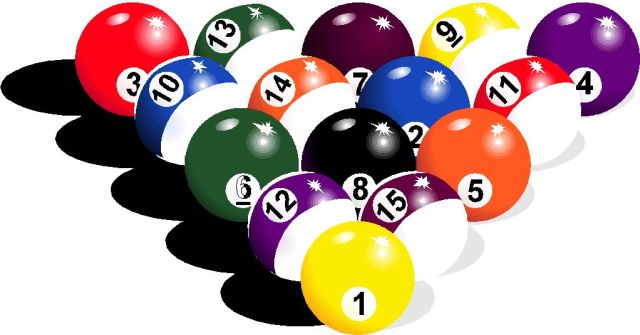
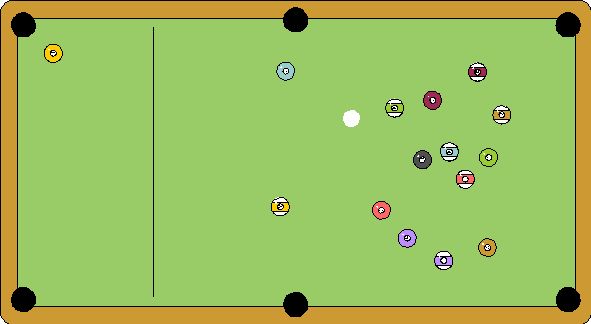
    Billiard balls on a billiard table are a good way to illustrate entropy. Billiard balls haphazardly scattered on a billiard table is an illustration of high entropy where the billiard table is the system and the balls are the elements in the system potentially available for work. The work might involve falling into a pocket hole where it triggers a lever to initiate another action like triggering another lever.

    Figure 2-2: Racked billiard balls. Elements of a system.

    For our purposes, the point is that the balls are scattered across the table. Entropy. The balls are not as readily available for work as they could be if they were racked or lined up in a row. This would not mean that the system has no entropy but rather it has less entropy than it could have. Scattered balls equal high entropy, ordered, line up balls equal relatively less entropy.

    What does this have to do with a definition of consciousness?

    At this point, a related question is whether you have ever seen an egg roll off a counter, shatter and splatter on the floor and then re-assemble into an egg again? Living in the same universe as most of us, the answer is no. The egg goes from a low entropy system (a formed egg with precise potential energy) to a higher entropy system (shell, yoke, egg white lying on the floor in another system we refer to simply as the environment). There is no logic or axioms in the physics of thermodynamics saying that an egg could not spontaneously re-assemble after breaking. But we have a very good scientific reason why it will most likely never happen and has everything to do with entropy.

    Let’s take a deep dive into our side tour.

    Reality Knowns and Known Unknowns

    In chapter six of The Fabric of the Cosmos3 titled “Chance and the Arrow “, Brian Greene provides an amazing explanation of the arrow of time involving eggs and ice cubes.

    How does an egg end up scattered and broken on a floor? A force pushed, pulled or dropped it. Why does it end up scattered and splattered on the floor? Because the forces holding the egg together are not strong enough to withstand the forces causing it to shatter and splatter. Well, after the egg has fallen to the floor, why can it not simply re-assemble to the shape and form it was after the force is no longer acting upon it?

    It is this latter question that Greene answers conclusively. It is not that the egg cannot re-assemble into its former self, it’s that the probability of it happening, the probability of us ever seeing a shattered egg re-assembling is so low that we consider it an impossibility. But it’s not.

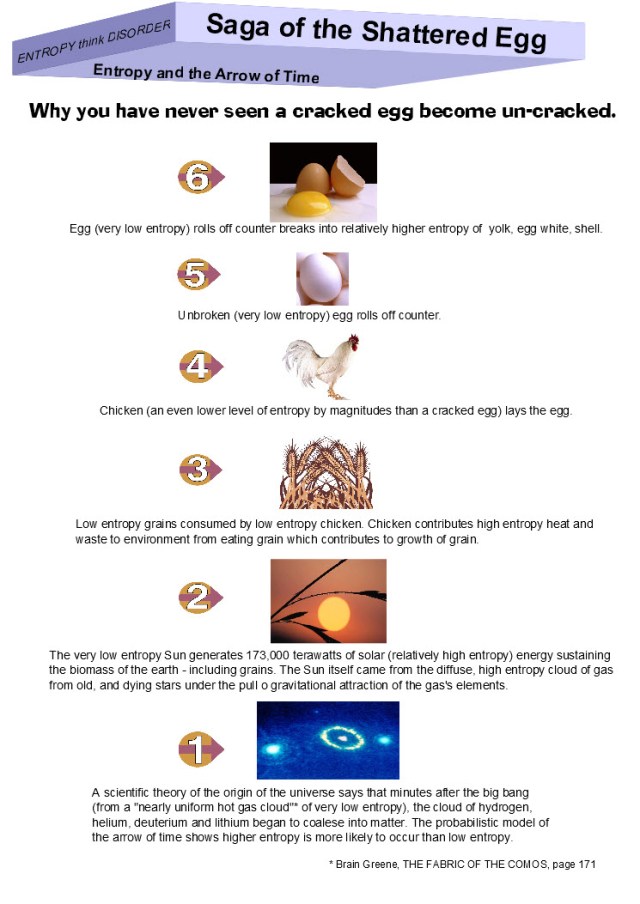
    Figure 3-2: Summary of the physical reality of entropy (order to disorder) the perception of time and change. A reading of Chapter 3 of THE FABRIC OF THE COSMOS by Brian Greene.

    The egg that shattered, the egg from the chicken that laid it, the feed that provided the food to nurture the chicken, to photosynthesis from the Sun radiating energy enabling the grains to grow, to the cosmic gas cloud that condensed to form the Sun, to the “big bang” that gave rise to the cosmic gas composed of elements and gravity that resulted in the sun resulting in our shattered egg.

    Greene shows that space-time is pretty much a one way street. The reason it’s a one way street is because we see the universe going from an incredibly low entropy state (the big bang) to an increasing entropy state where minuscule elements–suns, dust, planets, rocks–clump together into relatively lower states of entropy until they disintegrate again into high entropy. Greene uses this nice phrase to describe what we currently see in the universe. He writes, “the current order is a cosmological relic”.

    So the simple reason we never see a shattered egg reassemble is not because it’s an impossibility. The probability of it happening in a university evolving in space time from low to higher entropy goes against the flow of the universe.

    The Fungus Amongst Us

    What does entropy and the cosmological theory of the big bang giving us the origin of the universe have to do with a definition of consciousness?

    The point here is that stepping backwards through one of the laws of classical physics we arrive at an unknown. The big bang. The big bang theory of the creation of the universe may or may not be correct. But right now the laws of classical physics work quite nicely with the theory. It is science.

    Now, suppose we apply the same science based, logic trace to arrive at a definition of consciousness?

    Two things here.

    First, note that we did not include intelligence as an attribute commonly attached to a definition of consciousness. That does not mean there are no scientists or philosophers who do not include it. But intelligence, strictly speaking, is an attribute denoting the ability to apply skills to solving challenges of survival or just problems in general. According to Paul Stamets, citing a result from research in 2000 by Toshuyiki Nakagaki, in his 2005 book, MYCELIUM RUNNING(4), fungus demonstrates the intelligent ability to seek and find substance (food). If an expanding fungus can navigate a petri dish to find the quickest path to sustain its existence, that certainly demonstrates intelligence. Intelligence measured in degrees can apparently go from an Albert Einstein to mycelium (basically mushrooms), to scavenging cockroaches instinctively (or perhaps intelligently) scurrying away from light.

    Secondly, there is artificial intelligence and the–what? hope, dread, fear–that machines or robots will become so intelligent that they will acquire consciousness. This belief of course surfaces without having a definition of what constitutes consciousness–only the process by which consciousness is observed. But in the case of artificial super-intelligent robots, the anticipation is that the machines acquire so much knowledge that they start making value judgements. Value judgements. Remember that phrase. What will these super-intelligent machines do once they have acquired all the knowledge stored in every library in the world?

    For reasons (mostly unspecified, or loosely specified) super-intelligent robots would make their first order of business the eradication of humans. Looking at this from a purely scientific view, considering the law of thermodynamics and the useful energy humans contribute to the environment juxtaposed with their excessive consumption of the environment’s available energy, eradication might be a very logical option. So, once these super-intelligence machines have acquired all the knowledge available to humans and even extrapolated that knowledge beyond anything a human could conceive, and have eradicated humans from the planet. What do they do next?

    Being super-intelligent machines they would most likely gather on a beach in Santa Monic and wait for the Sun to turn into a red giant, engulfing all life on the planet. This is what a super-intelligent human would do especially since there would be no other humans around.

    Note that nothing these robots could do, from eradicating humanity to digesting and extrapolating all the knowledge in the world, is not anything any human could not do. Intelligence as a prerequisite for unraveling a definition of consciousness, like the other four attributes listed at the beginning, is merely an attribute, a description of consciousness, but is not a definition.

    So we leave our side tour into the scientific method that can arrive at scientific, empirical reality even though it may be derived from an unverifiable theory of reality. We are on treacherous ground. But the science is the science and despite its shortcomings, science gives us reality. Which, of course, brings us to neurology–the science of the brain. A hard reality befitting a “hard problem”. When it comes to neurology, science has a theory. Sort of like the big bang. Think fungus.

    © Lynard Barnes, 2020

    Share this:

    • Share on X (Opens in new window) X
    • Share on Facebook (Opens in new window) Facebook
    • Print (Opens in new window) Print
    Like Loading…
    May 24, 2023

  • Part I: PRELUDES OF CHANGE

    The Definition of Consciousness
    Me, I, My and Us, the MIMU of Self
    BY LYNARD – OCTOBER 12, 2020

    A year or so ago I set out to write a series of posts as a follow up to my 2012 book A SHORT HISTORY OF MEMORY. I slowly and methodically went through the tedious process of reading and collecting reference material.

    The book prompting this latest venture into the world of neuroscience was Michael S. A. Graziano’s1. Unlike some denser neuroscience works, Graziano explains the basics, lays out the foundation for what, he contends, may eventually be a full explanation of consciousness. He also raises some really, really important questions. One of those questions, the most important question he raises in fact is the central idea I presented as foundational to any explanation of consciousness. RETHINKING CONSCIOUSNESS makes an enormous contribution to setting the parameters around any valid definition of consciousness. Unfortunately, Graziano’s approach to a possible definition of consciousness is wrapped around the idea of humans as biochemical machines that can be emulated by a computer. The idea is quaint.

    In what I can only regard as a serendipitous interruption of my plan for a series of posts following up on my book, I read Douglas Phillips’ science fiction adventure, PHENOMENA: A NEUROSCIENCE THRILLER2. Phillips is not a neuroscientist. His forte is physics, quantum physics specifically, and computer science. A prolific author with an entire series of novels centered around quantum physics, in PHENOMENA, Phillips approaches the question of consciousness in the only way it can be approached if we are ever to arrive at an understanding. However, antithetical to every “serious” discussion of consciousness, Phillips’ deus ex machina is an alien intelligence of shared consciousness, which sort of begs the question–what is consciousness of an alien intelligence. Stripped of the alien intelligence aspect of the novel, Phillips zeros in on both the confining constraints of any real definition of consciousness and how it can really be defined.

    Since A SHORT HISTORY OF MEMORY neuroscience has continued progress on mapping the biochemical intricacies of the brain. The proliferation of theories on how the brain and mind work has also continued. What has remained consistent however is the analogy of the brain as a computer. From memory as computer-like random access memory to perception and reaction as a complex neural network of inputs and outputs. Of course using computer structure as an analogy for the way the brain works greatly simplifies explanations of how the brain works. It does nothing to explain consciousness despite the relevancy of complex neural networks or topography of Graziano’s “attention schema” theories.

    © Lynard Barnes, 2020

    Share this:

    • Share on X (Opens in new window) X
    • Share on Facebook (Opens in new window) Facebook
    • Print (Opens in new window) Print
    Like Loading…
    May 24, 2023

  • The Definition of Consciousness:
    Me, I, My and Us, the MIMU of Self

    I Have a Gripe

    For almost two years now I have been trying to understand the claim by some Republicans that the 2020 election was rigged and corrupt. I finally figured it out after reading about the trial of Oath Keepers leader Steward Rhodes.

    Rhodes took the stand in the group’s seditious conspiracy trial on November 3, 2022 and said he believed the election was “unconstitutional”. This is the first time I have heard of someone making a reasoned argument about a fraudulent election. But exactly what is an “unconstitutional” election?

    Step back a moment and ponder the Boston Tea party which occurred on December 16, 1773 at Griffin’s Wharf in Boston. The Sons of Liberty raided the three ships containing bulk tea from England and dumped 342 crates of the stuff into the harbor. By the time of the tea party, the phrase “no taxation without representation”, coined five years earlier, had become sort of a litmus test of republican governance.

    Now step a little closer to America. When the U. S. Constitution was adopted on June 21, 1788, it left voting rights, hence representation, up to the states. Only white Anglo-Saxon Protestant males over the age of twenty-one and who owned property qualified as voters in almost all the states. This is where things get really interesting. Remember that phrase, “No taxation without representation”.

    Closer still. On July 9, 1868 the 13th Amendment freed a bunch of people from slavery who were definitely not Anglo-Saxon. The amendment granted them citizenship. States still had the right to determine who could and could not vote and just being a citizen was not enough for some States. Then, on February 3, 1870, the 15th Amendment was passed granting Black Men the right to vote and Congress the power to make sure the right was not infringed upon by the States. Black women were left out of this change in civic participation. Women, both Black and White, were subject to taxes but were not represented. In the colonial American heritage of representative democracy, this was blatantly unfair. Fifty years later, on August 18, 1920, women were granted the right to vote under the 19th Amendment. Still, some southern states did not allow Black women to vote. Finally, on July 1, 1971 the 26th Amendment was adopted granting 18-year-olds the right to vote. This last granting of voting rights seems to be based on a variation of the “No taxation without representation”, to “No taxation nor maimed body nor sacrificial death in war without representation”. (For a more detailed discussion of these voting-right changes, go to HISTORY STORIES ). So what is an “unconstitutional” election.

    We have gone from Anglo-Saxon male property owners 21 years and older with the right to vote to any American citizen over eighteen years old. So the constitutional question of the 2020 election cannot be a question of constitutionality. In a representative democracy, we would like anyone eligible to vote to in fact vote. However–and I will take flak for this–if we are relying upon a classical republican principle of “No taxation without representation” then minors below 18 years of age, including the paperboy and baby-sitter who relinquish part of their earnings (through their parents most likely) to taxes are not being represented. This does not make the 2020 election “unconstitutional” but it does make it a highly questionable implementation of elective representation. But I digress.

    Now, there are some restrictive laws in the States which may disqualify a citizen from voting. What Mr. Rhodes may have been thinking when he said the 2020 election was “unconstitutional” is that some States changed the procedures by which citizens could vote. Mail-in ballots, drop-boxes. Next thing you know States could allow voters to vote via their computer appliance. What’s the world coming to? Don’t answer that. I have the answer right here. When I started that question it was 1:45 PM when I looked at my watch. It is now 1:45 PM and some seconds. You see, things are constantly changing.

    Apparently what Mr. Bannon wants to do is go back to the original circumstances of the U. S. Constitution. That’s fair. Only Anglo-Saxon men over 21 years old should be allowed to vote and thus be represented in governance. Fair indeed. But then there is the question of taxation without representation. If America repudiates this fundamental rationale for the establishment of American democracy, then it might as well become one of those “-isms” like fascism or communism or, perhaps more appropriately, a plutocracy.

    The first American President, George Washington, said that America seemed to be the last great experiment for promoting human happiness. It is an experiment that has lasted for over two-hundred and thirty years. Not all the people have been happy. And it has been messy. But as history has demonstrated, the experiment evolves. Evolve it must. Even now the nation–or at least some States in the nation–has not learned how to efficiently do something as simple as count votes, let alone recognize citizens eligible to vote. Saying an election is “unconstitutional” is an amazingly meaningless statement. If Mr. Bannon had predicated his seditious insurrection upon a contention that the 2020 election was tainted by violations of voting laws, he would at least have had a legal leg to stand on. The leg would be a phantom of course. But phantom legal legs seem to be a thing in the current state of representative democracy. There is something to be said about that. Being a voting American in relatively good standing, I have something to say about it.

    Share this:

    • Share on X (Opens in new window) X
    • Share on Facebook (Opens in new window) Facebook
    • Print (Opens in new window) Print
    Like Loading…
    November 10, 2022

  • Compost Pile for Fall Leaves – 22 October 2020

    Last season (fall 2018) I started a compost pile for the falling leaves of the four trees in our yard. I did it to reduce the number of twenty-plus 34 gallon leaf bags I had to fill and set at the curb to be picked up by the city. The fee charged for the pickup is included in the monthly city garbage pickup fee. The city allows leaves to be placed in open containers as opposed to bags for curbside pickup. Unless you just have an affinity for moving containers of leaves around, bagging is preferable. If you think stuffing leaves into a paper bag is a good waste of paper bags, you opt for a compost pile. More importantly, if you learn a little, as I did, about what happens on a forest ground with falling leaves, you sort of like the idea of a compost pile.

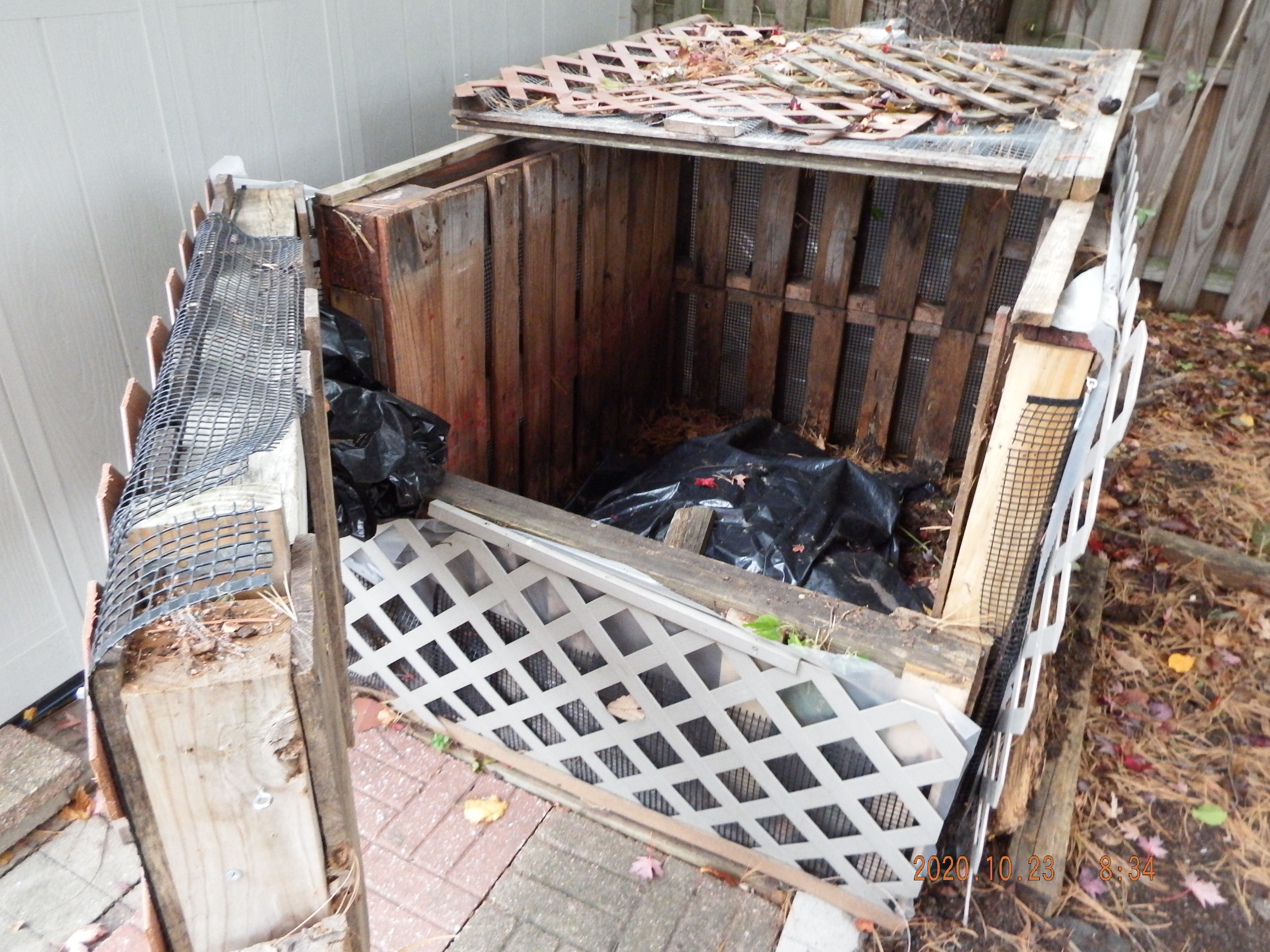
    My original compost bin was constructed from pallets. These pallets were the same pallets on which I received the four hundred retainer bricks I used to build the raised garden sitting on top of the French drain I made in 2017 (see below).

    Figure 1: Compost bin constructed from four HT (heat treated, not MB) pallets. Not much thought went into its construction because was designed simply to contain leaves and compost material and keep pests (primarily racoons) out. The bin measured 4 feet wide and long and 4 feet high.


    I placed brown leaves from the yard into the bin in the fall of 2019 after finishing the compost construction in July 2019. For the next seven months I added kitchen waste–greens discards, a few grass clippings, coffee grinds, egg shells, etc.. I stopped adding material to the bin at the beginning of April 2020. I did not anticipated having compost soil until a year later.

    This year we cut down a forty-year-old Black Locust tree in the front yard, leaving a whittled down tree stump about five inches below ground level. To my complete and utter surprise the compost pile I started last year contained enough compost soil to cover and level the stump area. I planted new grass and ten days later I had grass.

    New Compost Bin

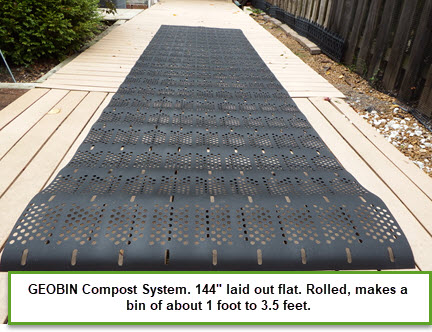
    My success with the do-it-yourself compost bin prompted me to go a step toward “professional”. I purchased a GEOBIN Compost System and a compost thermometer. Nothing spells professional more than a compost thermometer.

    Figure 2: GEOBIN Compost System is shipped as a roughly 6 inch square, 4 feet long boxed tube along with closure keys and an instruction sheet with all the information necessary to put it together.


    Figure 3: The circumference of the bin is determined by how many times you wrap the material around in a circle. I wrapped it three time in order to get a bin measuring roughly a foot and a half in circumference. (Volume equals pi [3.1415] times radius squared times height–in case you want to know).

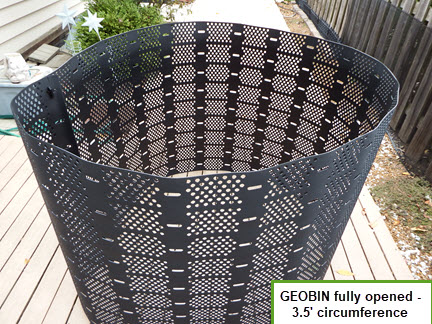
    Figure 4: The picture above is the bin fully wrapped to its 4 feet circumference. The instructions recommend extending to only 3 and ½ feet by not placing the keys in the first key slots. The determining factor as to how big the bin should be is the amount of material you anticipate putting into it.

    Having already started my DIY compost bin with grass cuttings, kitchen scraps and fall leaves, I decided to place the GEOBIN next to my old bin and start filling it with the first leaf fall of the season.

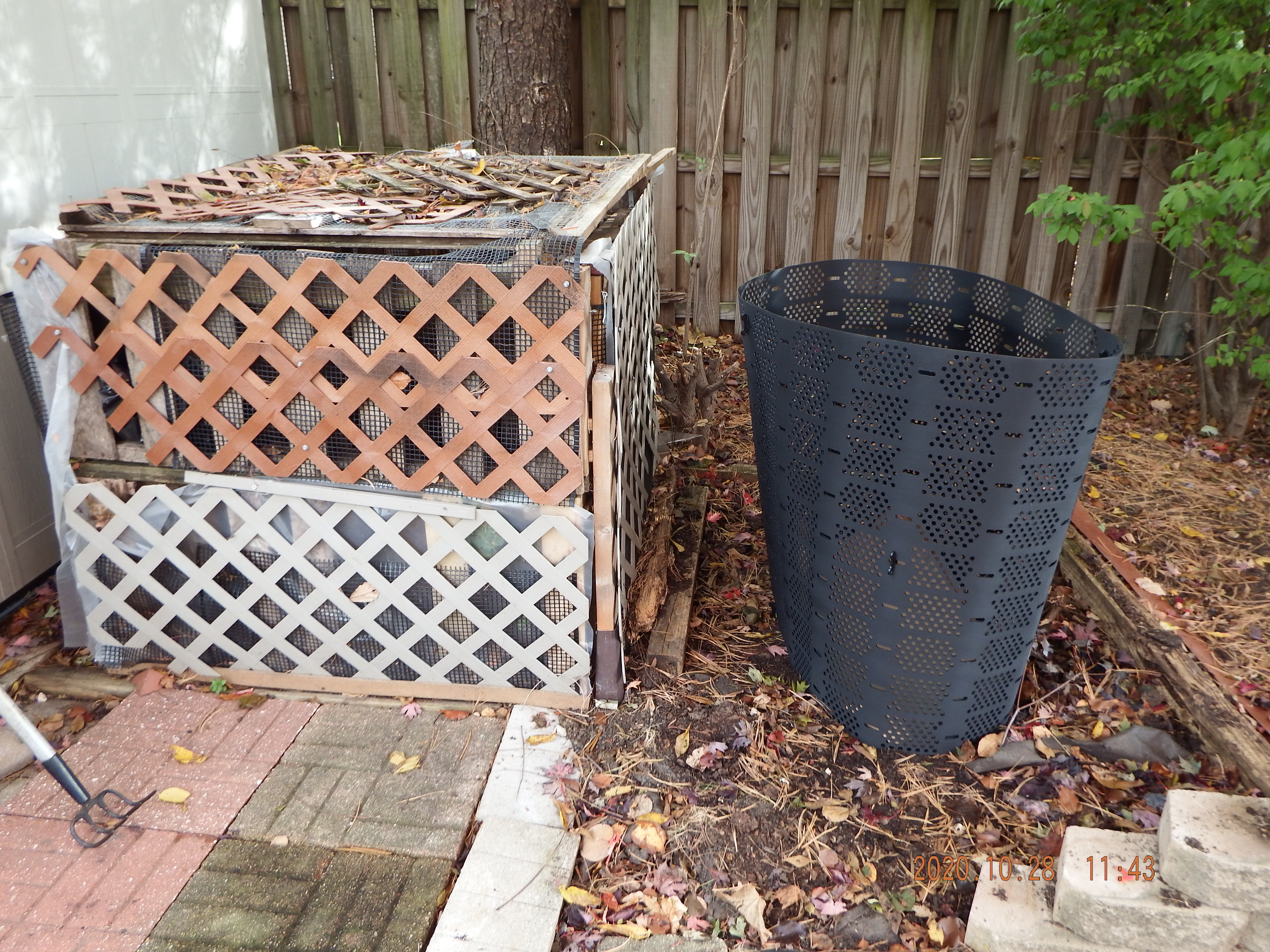
    Figure 5: Compost bin made from shipping pallets on the left with lattice siding and new GEOBIN compost bin on the right.

    It took roughly a year for the leaves, grass clippings and kitchen scraps to disintegrate into soil in my DIY bin. While I have read that the proportion of brown (leaves) to green material (grass clippings, kitchen vegetable waste, coffee grinds) is important in determining how long it takes for the pile to be reduced to dirt (or humus for predominately green matter0, I really did not pay any attention to proportions. There was definitely more leaves than grass. After using the DIY soil to fill the void left by the Black Locust tree, I started the new pile again with mostly leaves.

    Figure 6: GEOBIN compost bin quarter filled with shredded leaves, grass clippings and vegetable kitchen scrap.


    A week after starting the GEOBIN pile, the internal temperature had reached an optimal one-hundred and thirty degrees. By the fall of 2021 I expect to have enough dirt to level-off a few spots in my lawn.


    Share this:

    • Share on X (Opens in new window) X
    • Share on Facebook (Opens in new window) Facebook
    • Print (Opens in new window) Print
    Like Loading…
    November 1, 2020
    leaves, waste, Yard

  • So. Why Build a French Drain/ Nobody Asked

    Ten years ago, I looked at half of the front yard of our newly purchased house and had an idea. A garden wall. Sit, talk, watch the stars. Plant some flowers too, though I am not a flower person. Over the years I had developed an extreme dislike for the pebbles covering the area. I hate pebbles. (No disrespect to Fred. Or was it Barney? I could never get that resolved).

    Digging Stuff
    Laying out the wall was easy. Digging the trench for drainage around the wall was dictated by the location of the wall. I discovered that the drainage should be behind the wall, not in front of it. A major tidbit of knowledge. If left to my own devices, I am pretty sure I would have dug the trench in front of the wall. Live and google and learn, right?

    (more…)

    Share this:

    • Share on X (Opens in new window) X
    • Share on Facebook (Opens in new window) Facebook
    • Print (Opens in new window) Print
    Like Loading…
    July 9, 2018

  • Garden Pictures

    Sweet 100 Cherry Tomatoes

    Bitter Melons

    Cayenne Peppers

    Share this:

    • Share on X (Opens in new window) X
    • Share on Facebook (Opens in new window) Facebook
    • Print (Opens in new window) Print
    Like Loading…
    July 8, 2018

  • The Best Orange Chicken 橙皮雞

    soupsahoy's avatarSoups Ahoy

    Vitamin C isn’t the only reason we adore oranges. Come Chinese New Year everything orange is considered good luck. The vibrant orange color looks similar to gold color. And gold means fortune. Tangerines, mandarin oranges and clementines can also brighten up your holidays and

    View original post 89 more words

    Share this:

    • Share on X (Opens in new window) X
    • Share on Facebook (Opens in new window) Facebook
    • Print (Opens in new window) Print
    Like Loading…
    February 7, 2018

  • Banana Pecan Bread

    soupsahoy's avatarSoups Ahoy

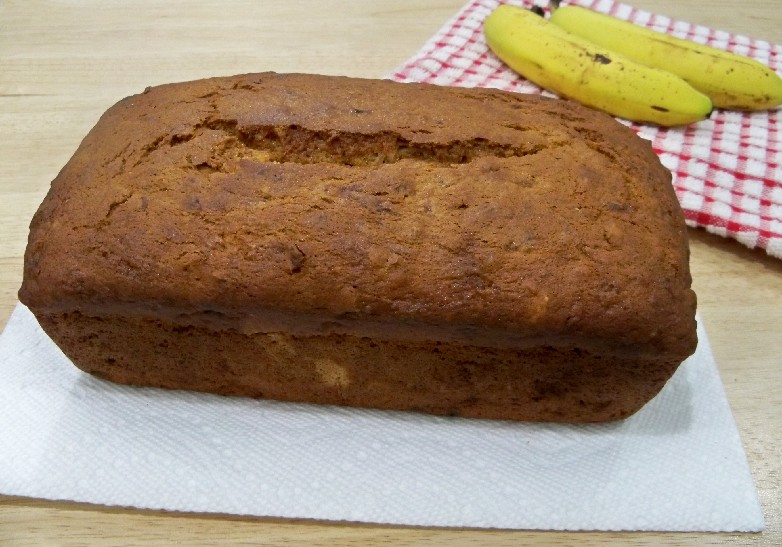
    Making bread at home is quite a novel idea for today’s busy women. I personally do not like the idea of kneading dough by hand. Thanks to bread machines and quick bread recipes, this daunting task is not as intimidating as it used to be. After making different versions of quick bread, I especially like making banana bread. I like the wholesome, sweet flavor. As it turned out, simple ingredients

    View original post 93 more words

    Share this:

    • Share on X (Opens in new window) X
    • Share on Facebook (Opens in new window) Facebook
    • Print (Opens in new window) Print
    Like Loading…
    February 7, 2018

  • A Call From New Jersey

    Couple of days ago I got a call from New Jersey. At least, the caller ID said “New Jersey”. This was the most exciting call I have received in some time. Usually my calls are from “Anonymous”, or “Unknown Caller”, or “Invalid Number”, or “Customer Service”, or “ID Blocked”, or even sometimes “1″. These callers are different from the “New Jersey” caller of course. I don’t know any of the others, so I never even bother to pick up the phone. I do know New Jersey. I have no idea why New Jersey would be calling me. I did not answer the call. Thought maybe they would leave a message. Still, I am honored to have received the call and can not for the life of me figure out (more…)

    Share this:

    • Share on X (Opens in new window) X
    • Share on Facebook (Opens in new window) Facebook
    • Print (Opens in new window) Print
    Like Loading…
    April 3, 2017

Previous Page Next Page

Website Powered by WordPress.com.


Loading Comments...
 

    • Subscribe Subscribed
      • Barnesfolio
      • Already have a WordPress.com account? Log in now.
      • Barnesfolio
      • Subscribe Subscribed
      • Sign up
      • Log in
      • Report this content
      • View site in Reader
      • Manage subscriptions
      • Collapse this bar
    %d